


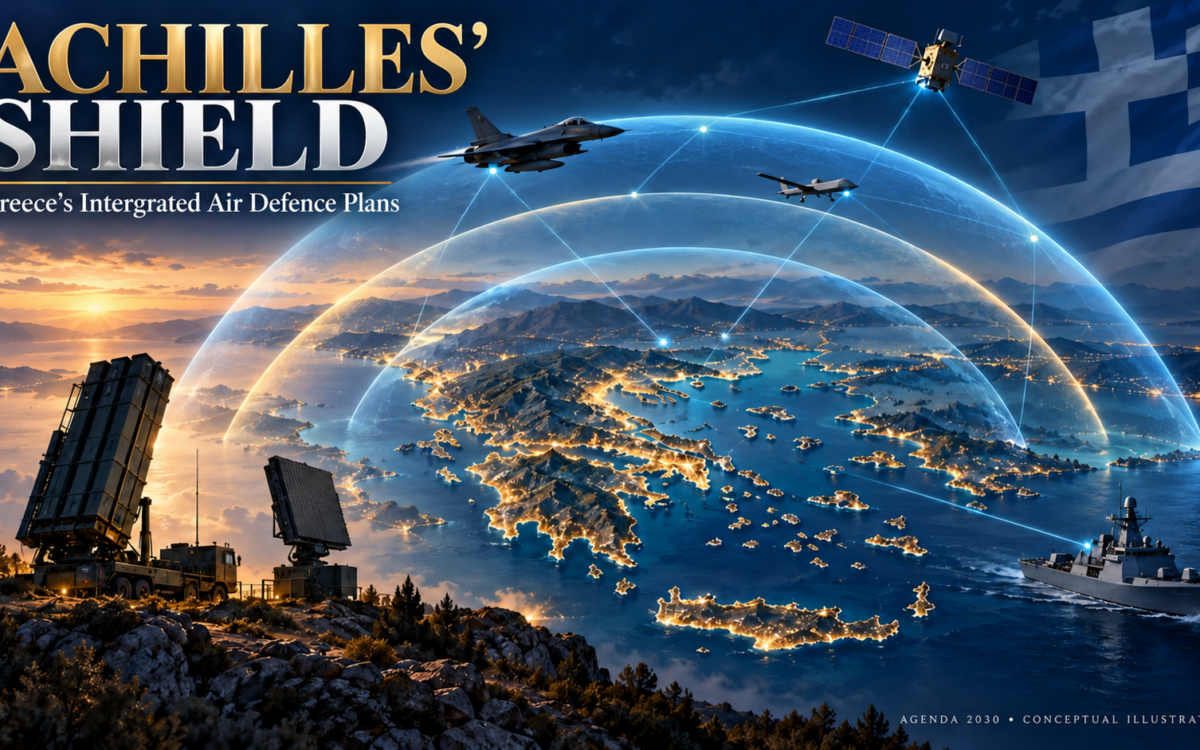
Greece Advances Achilles’ Shield and Armed Forces Modernisation Under Agenda 2030
Greece’s Minister of National Defence, Nikos Dendias, has outlined a comprehensive transformation of the Hellenic Armed Forces, placing integrated air and missile defence, autonomous systems, space capabilities and domestic industrial participation at the centre of national planning. In an interview with journalist Marinos Gkasiamis published in TA NEA on 31 October 2026, Dendias described the progress of Achilles’ Shield and a wider equipment programme spanning all three services. His central message was that Greece must move beyond acquiring individual platforms towards building an interconnected military organisation, supported by national technological expertise and production capacity. Under the Agenda 2030 reforms, stronger armed forces are intended to provide credible deterrence and the confidence to address evolving regional challenges.
Achilles’ Shield forms the cornerstone of this approach. According to Dendias, the programme is already being implemented, with full operational readiness expected within 34 months of the interview and individual systems delivered progressively. He described an integrated architecture of overlapping defensive layers covering Greek territory through a unified command-and-control system. Some associated weapons were displayed during the 28 October military parade in Thessaloniki. Dendias stressed that the architecture matters more than any single component: the objective is to connect new equipment with existing capabilities and create a coordinated national defensive network. Equally important is the acquisition of expertise, with Greek defence industry expected to secure participation of at least 25 per cent.
The minister identified David’s Sling as the outer layer, intended to intercept tactical ballistic missiles and long-range cruise missiles. Barak MX would provide the intermediate layer, while Spyder would cover short- and medium-range requirements, replacing older systems. Advanced radars would underpin the architecture, with a national command-and-control system acting as its coordinating centre. This would connect existing Patriot batteries, combat aircraft, naval units and sensors across the services, extending, in the minister’s description, down to a soldier’s helmet-mounted sight. The intended result is a shared operational picture through which different platforms and sensors contribute to collective defence. His account presented these systems as elements of the planned architecture, without providing separate contractual or delivery details for each component.
Dendias characterised the transformation as a transition from C4I to C5ISRT, incorporating cyberspace, intelligence, surveillance, reconnaissance and targeting alongside command, control, communications and computing. The platform would gather information from available sensors, process and prioritise it, recommend appropriate responses and support targeting. Rather than operating as separate collections of personnel and weapons, the services would function as a unified organisation. Counter-drone capabilities constitute another essential element. Dendias said the domestically developed Centaurus system, associated with cooperation between the Hellenic Centre for Defence Innovation, ELKAK, and Hellenic Aerospace Industry, already operates aboard Hellenic Navy frigates. He also stated that Greek-made portable counter-drone systems are entering mass production, reinforcing the role of national technology in addressing emerging threats.
Maritime autonomy represents another priority. Dendias described the memorandum between ELKAK and the MIT Sea Grant programme as the next stage of cooperation initiated two years earlier with an educational focus. He recalled training delivered in June by MIT academics and researchers to Hellenic Naval Academy cadets and members of Greece’s scientific community, combining theoretical instruction with practical sea trials. Separately, he reported successful trials of Saronic’s Corsair unmanned vessel and said Greece had submitted a procurement request through an intergovernmental arrangement for a substantial number of craft. The Government Council for National Security had also approved special operations underwater vehicles, eight of which would be built at Skaramangas. The broader ambition is European leadership in autonomous platform development by 2030.
The Long-Term Defence Equipment Programme is being updated to reflect these priorities and lessons from conflicts in Ukraine, the Caucasus and the Middle East. Dendias highlighted the ability of inexpensive systems to inflict disproportionately costly damage, alongside the growing importance of drones, swarms and unmanned underwater platforms. Artificial intelligence, space, cyberspace and the electromagnetic spectrum increasingly shape operational planning. Equipment decisions are also being linked to force restructuring. He said the third phase would abolish 56 units and 126 organisational structures, generating €530 million in savings over five years, with another €600 million saved from equipment of diminished operational value. The intention is to redirect savings towards priority needs, particularly military personnel remuneration.
Space capabilities feature prominently in the revised programme. Dendias outlined a military-specification geostationary satellite, three medium-orbit satellites through the European IRIS programme, radar satellites developed in cooperation with Poland and a constellation of photographic microsatellites. A Space Command is scheduled to be inaugurated in December. In aviation, he prioritised Achilles’ Shield alongside F-35 aircraft, with initial deliveries expected in 2028, modern weapons and the upgrade of 83 F-16s to Viper standard. His naval outline included two additional FDI frigates during 2026, an initial two Bergamini-class FREMM frigates with plans for another two, two minehunters with provision for two more, and MEKO modernisation. Other programmes include C-390 transports, Apache missiles, additional V-BAT and HERON systems, and underwater platforms.
Domestic industrial involvement is intended to become a structural requirement throughout this effort. Dendias said participation of at least 25 per cent by the Greek defence ecosystem would be legislated, supporting production capacity and potential exports to Europe and the Middle East. He also called for particular emphasis on cyber defence through 2030, citing the capabilities artificial intelligence could offer potential adversaries. On regional affairs, he maintained that ratification in Benghazi would not alter Greece’s rejection of the Turkish-Libyan maritime memorandum, while warning about Turkish influence in eastern Libya. He similarly criticised Turkey’s Blue Homeland agenda and rejected any erosion of Greek sovereignty or sovereign rights. Regarding the Greece–Cyprus electricity interconnection, he said the project fell outside his ministry’s responsibilities and expressed hope that its involvement would remain limited to the relevant NAVTEX procedures. Across these issues, Dendias linked diplomatic resolve with credible military deterrence. His interview presented Agenda 2030 as a combined operational, technological and industrial undertaking whose success depends on integration, implementation and the development of enduring national capabilities.
 Greek
 English