


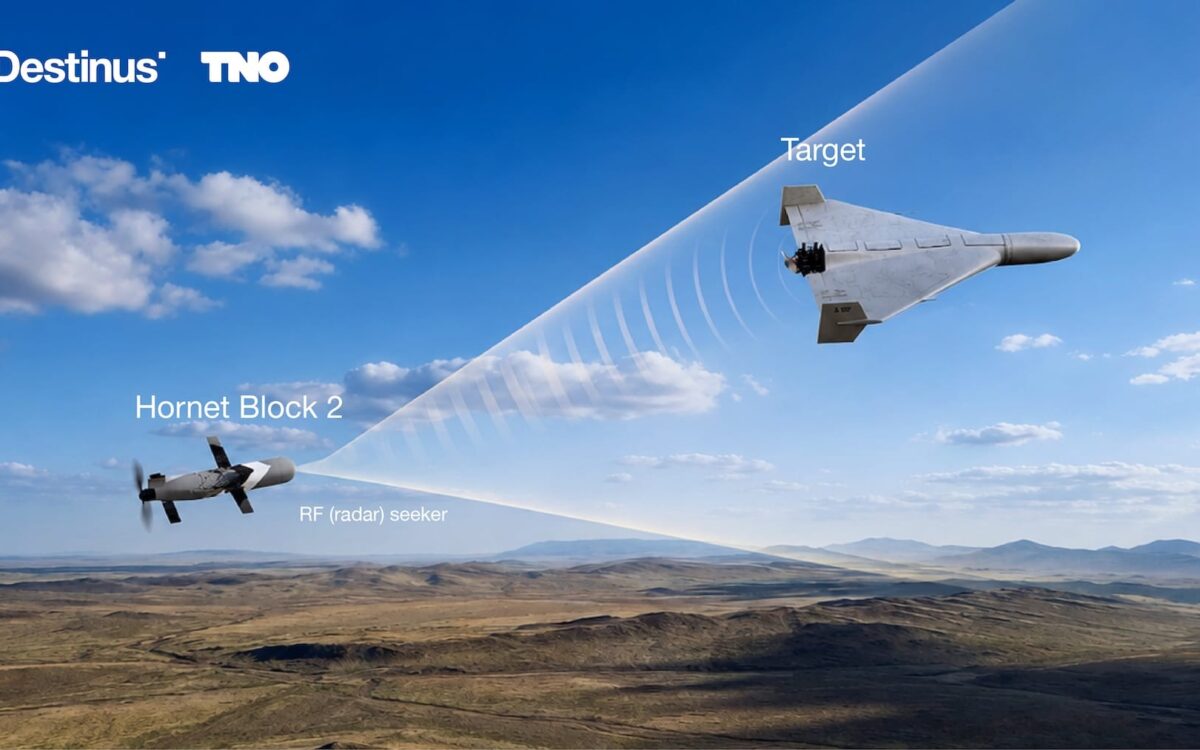
TNO and Destinus Launch Joint Venture to Advance European Radar Seeker Technology
Europe’s efforts to strengthen its air and missile defence capabilities have received a significant boost following the announcement that TNO and Destinus intend to establish a joint venture dedicated to the development, industrialisation and production of advanced radio-frequency (RF) radar seeker technology for next-generation interceptor systems. Subject to the necessary regulatory approvals, the new company is expected to be formally established in 2026 and will focus on delivering critical guidance technology for future European air defence systems.
The collaboration brings together TNO’s extensive expertise in radar research and advanced sensor technologies with Destinus’ capabilities in system engineering, integration, industrialisation and large-scale production. The objective is to accelerate the transition of innovative technologies from laboratory development into operational military systems while strengthening Europe’s defence technological and industrial base.
The centrepiece of the programme is an active RF seeker approximately the size of an ice hockey puck, designed to serve as the primary sensor during the terminal guidance phase of modern precision interceptor systems. The seeker enables accurate target detection, tracking and discrimination, even in challenging operational environments characterised by darkness, poor visibility, adverse weather conditions and electronic countermeasures. Unlike purely electro-optical guidance systems, radar seekers maintain their effectiveness under conditions where optical sensors may experience degraded performance, making them an increasingly important component of modern integrated air and missile defence architectures.
Under the planned joint venture, TNO will continue to lead the development and validation of radar technologies, system architectures and associated scientific knowledge, while Destinus will be responsible for engineering, system integration, industrialisation and bringing the technology to market as part of deployable interceptor solutions. The partners expect the first demonstration products to be available early next year, marking an important milestone in the programme’s development.
The initiative reflects the growing recognition across Europe that strategic autonomy in defence increasingly depends on securing access to critical enabling technologies rather than solely manufacturing military platforms. Advanced guidance systems, including RF seekers, are regarded as one of the key technologies required to improve the effectiveness of interceptor systems against increasingly sophisticated aerial threats ranging from cruise missiles and unmanned aerial vehicles to other high-speed targets.
According to Tjark Tjin-A-Tsoi, Europe’s future defence capability will depend not only on the production of platforms but also on maintaining control over the advanced technologies that make those systems operationally effective and reliable. He noted that accelerating the availability and large-scale production of such technologies would also create significant opportunities for Dutch high-tech companies to participate in the European defence supply chain.
Tim Moser, Group Chief Technology Officer of Destinus, highlighted the operational importance of radar seekers, noting that they significantly improve interceptor performance in environments where optical guidance systems face inherent limitations. He added that combining TNO’s radar expertise with Destinus’ experience in system architecture and industrialisation would accelerate the delivery of advanced interceptor technologies for European air defence programmes.
The announcement also represents one of the first tangible outcomes of the recently signed Letter of Intent between the Dutch Ministry of Defence and TNO, which seeks to accelerate the transition of defence research into deployable military capabilities while strengthening the Netherlands’ position within European defence and dual-use industrial value chains. Dutch State Secretary for Defence Derk Boswijk welcomed the initiative, stressing that the current geopolitical environment requires rapid innovation, closer cooperation between government, industry and research organisations, and the faster scaling of Europe’s defence industrial capacity.
As European nations continue to invest heavily in integrated air and missile defence capabilities in response to evolving security challenges, the planned TNO–Destinus joint venture highlights the increasing importance of indigenous sensor technologies and industrial cooperation in reducing dependence on non-European suppliers while accelerating the delivery of next-generation interceptor systems.
 English
  Greek
Greek