


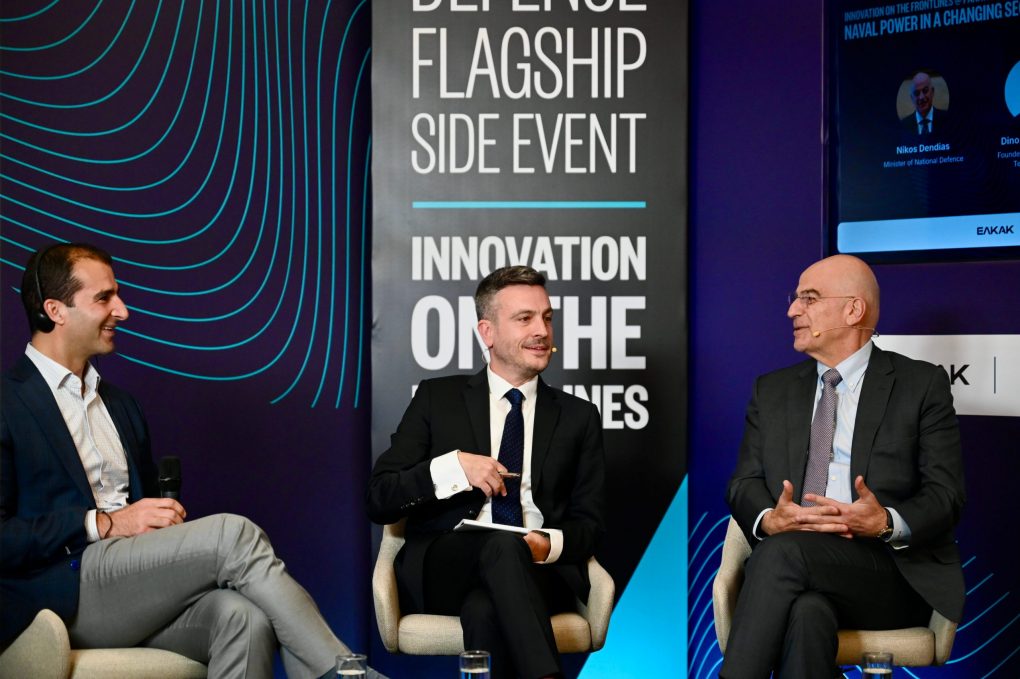
Naval Power in a Changing Security Environment: Hellenic Navy Balances Fleet Modernization and Emerging Technologies
The future of maritime warfare, the role of technological innovation, and the evolution of naval power in an increasingly complex security environment were the central themes of a high-level Defence Side Event organized by the Hellenic Centre for Defence Innovation (ELKAK) during the Panathenaia forum. The discussion, entitled “Naval Power in a Changing Security Environment”, brought together Greek Minister of National Defence Nikos Dendias, Saronic Technologies Co-Founder and CEO Dino Mavrookas, defence journalist Vassilis Nedos, senior military leaders and representatives of Greece’s defence and innovation ecosystem.
The event highlighted a growing reality facing naval forces worldwide: while major surface combatants remain essential instruments of national power, emerging technologies are fundamentally reshaping the way maritime operations are conducted. Autonomous systems, artificial intelligence, advanced sensors, data fusion, swarm technologies and unmanned maritime platforms are increasingly becoming key components of future naval warfare.
Speaking during the discussion, Defence Minister Nikos Dendias stressed that Greece’s approach to maritime security is based on a dual-track strategy. On one hand, the country is investing heavily in the modernization of its conventional naval capabilities. On the other, it is seeking to exploit emerging technologies that can serve as force multipliers in an increasingly contested operational environment.
According to Dendias, the first priority after the country’s decade-long economic crisis was to address critical capability gaps that had accumulated between 2010 and 2019. During that period, limited financial resources constrained investments not only in new systems but also in the maintenance and modernization of existing platforms.
As a result, Greece launched an ambitious naval modernization program aimed at restoring and enhancing the operational effectiveness of the Hellenic Navy. Central to this effort is the acquisition of three plus one FDI HN frigates from France, vessels widely regarded as among the most advanced multi-mission warships currently entering service in Europe. The minister described the FDI configuration selected by Greece as one of the most capable versions available, providing advanced air defence, anti-submarine warfare and network-centric operational capabilities.
In parallel, Greece has reached an initial understanding with Italy regarding the potential acquisition of two plus two Bergamini-class frigates. These vessels would further strengthen the Navy’s surface fleet and complement the capabilities introduced through the FDI program. At the same time, the modernization of the four MEKO-class frigates is moving forward, ensuring that these important assets remain operationally relevant for years to come.
The minister also referred to the continued use of selected Kortenaer-class frigates in secondary roles, creating
a balanced force structure capable of supporting national defence requirements while new capabilities are introduced.
However, the central message of the conference was that future naval superiority cannot rely solely on large and sophisticated surface combatants. The security environment has changed dramatically, and recent conflicts have demonstrated that relatively inexpensive autonomous systems can threaten highly valuable military assets.
Developments in Ukraine, the Red Sea and other operational theatres have highlighted the growing importance of unmanned technologies. Small autonomous platforms operating individually or as part of coordinated swarms are increasingly capable of conducting reconnaissance, surveillance, electronic warfare and strike missions. Such systems can impose significant costs on adversaries while remaining comparatively inexpensive to produce and deploy.
For Greece, these developments are particularly relevant given the unique geography of the Aegean Sea. The archipelagic nature of the region creates both challenges and opportunities for maritime operations. Future concepts of operation are therefore expected to integrate large naval platforms with extensive networks of autonomous surface and underwater systems capable of operating throughout the maritime battlespace.
Dendias emphasized that future naval forces must be able to combine traditional warfighting capabilities with distributed autonomous operations. In such a model, major surface combatants would continue to perform strategic missions while unmanned platforms provide enhanced situational awareness, surveillance coverage and operational flexibility.
One of the key issues discussed during the conference was the development of swarm technologies. The ability to deploy large numbers of autonomous maritime platforms working together through artificial intelligence and advanced communications networks is increasingly viewed as a potential game changer in naval warfare. Swarms of unmanned surface vessels and underwater systems could perform missions ranging from intelligence gathering and target tracking to offensive operations and area denial.
The minister acknowledged that Greece is actively exploring such concepts and seeking solutions tailored to the specific operational requirements of the Aegean environment. While significant progress has already been achieved in some areas, the development of autonomous maritime swarm capabilities remains a major objective for the future.
A prominent example of Greece’s innovation-driven approach is the “Centaur” counter-drone system. Developed through cooperation among ELKAK, the Armed Forces Research Centre (KETAK), the Hellenic Aerospace Industry and private-sector partners, the system has successfully demonstrated its effectiveness against unmanned aerial threats. Following operational testing in the Aegean, the system was subsequently deployed in real-world operational conditions in the Red Sea.
The success of Centaur illustrates the broader role envisioned for ELKAK within Greece’s defence ecosystem. Rather than focusing exclusively on procurement, ELKAK seeks to stimulate innovation by identifying operational challenges and encouraging industry, academia and research institutions to develop practical solutions.
Artificial intelligence was another major theme of the discussion. AI-enabled technologies are expected to play a crucial role in future naval operations by improving decision-making processes, accelerating threat detection, enhancing sensor integration and supporting autonomous navigation. As the volume of operational data continues to grow, the ability to process and exploit information rapidly will become a decisive factor in maritime warfare.
Beyond technology, the conference also addressed the importance of strengthening Greece’s defence industrial base. Dendias reiterated the government’s policy requiring at least 25 percent domestic industrial participation in major defence procurement programs. The objective, however, extends beyond simple manufacturing participation. The ultimate goal is the transfer of technology, the development of local expertise and the creation of sustainable industrial capabilities capable of supporting future innovation.
The minister stressed that Greece must leverage both its domestic talent and the expertise of the Greek diaspora. Scientists, engineers and entrepreneurs operating in leading institutions and technology companies around the world represent a significant strategic resource that can contribute to the country’s technological advancement.
As Europe increases defence spending and seeks to strengthen its industrial capacity, Greece aims to position itself as an active participant in the emerging defence innovation landscape. Through partnerships with international companies and investments in advanced technologies, the country hopes to build capabilities that not only support national security but also contribute to broader European defence objectives.
The conference concluded with a clear message: naval power in the twenty-first century will be defined not only by ships, weapons and platforms, but by innovation, adaptability and technological superiority. For Greece, maintaining maritime security in a rapidly evolving strategic environment will require a careful balance between fleet modernization and the adoption of disruptive technologies. The discussions at ELKAK demonstrated that the Hellenic Navy’s future vision is increasingly focused on combining both approaches into a coherent and effective force structure capable of meeting the challenges of tomorrow.
 English
  Greek
Greek