


KYSEA Approves Ten Major Defence Programmes as Greece Accelerates “Agenda 2030”
New air and missile defence architecture, counter-UAS systems, UAVs, satellites, C-390 transports/tankers, VICTA underwater vehicles, MEKO anti-submarine systems and Hellfire missiles form the latest stage of the transformation of the Hellenic Armed Forces
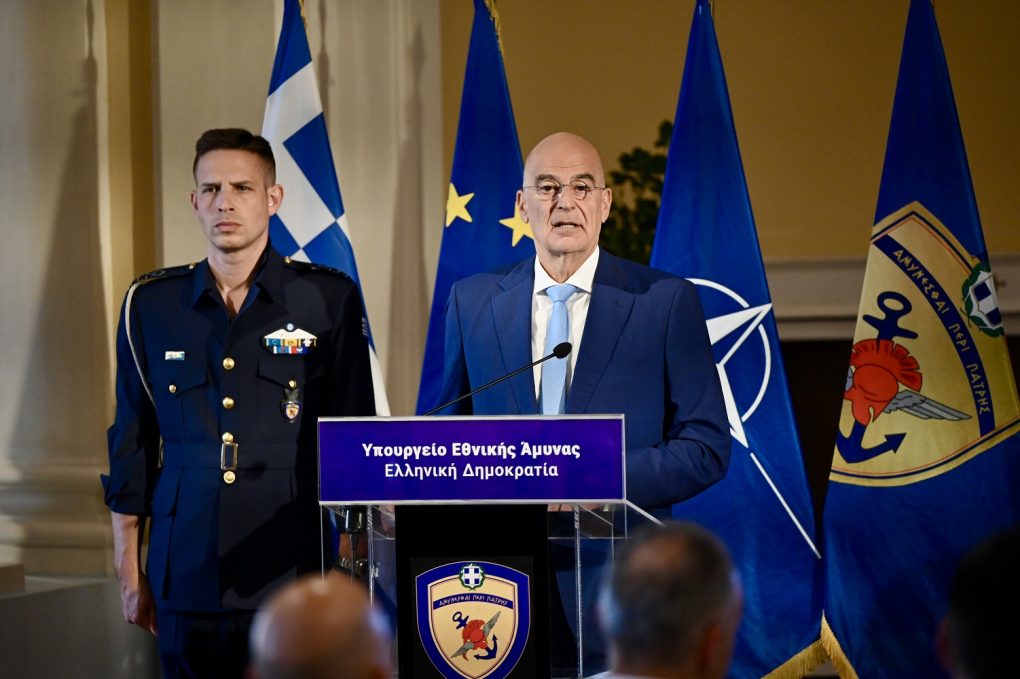
Greece has activated ten major defence programmes following their approval by the Government Council for National Security (KYSEA) on 23 July 2026, marking another important step in the implementation of the Ministry of National Defence’s “Agenda 2030” and the country’s Long-Term Defence Procurement Programme. Defence Minister Nikos Dendias presented the programmes following the KYSEA meeting chaired by Prime Minister Kyriakos Mitsotakis, stressing that the objective is not simply the acquisition of new platforms and weapons, but the transformation of the Hellenic Armed Forces into an integrated, network-centric force. Central to this transformation is the transition from the traditional C4I concept to what the Minister described as C5 ISRT: Command, Control, Compute, Communicate, Cyber, Intelligence, Surveillance, Reconnaissance and Targeting. The objective is to establish an architecture capable of collecting information from the entire network of Greek sensors, processing and prioritising that information, identifying threats and proposing the appropriate means of engagement and targeting.
1. Integrated Air, Missile and Counter-Drone Defence Shield
The most significant of the ten programmes is the creation of the new integrated air, anti-ballistic missile and counter-drone defence architecture. The system will consist of a series of weapon systems creating successive and overlapping protective “domes” across the Greek territory, connected through an integrated command-and-control system. Dendias subsequently confirmed that the total value of the air-defence component is slightly above €3 billion. Full operational capability is expected within 35 months, although individual components will be delivered progressively during that period. A particularly important aspect of the programme is Greek industrial participation. According to the Minister, this will exceed 25%, representing more than €700 million from the specific €3 billion procurement. Dendias clarified that this amount concerns Greek participation in the Greek order itself and does not depend on future exports. However, Athens’ objective goes considerably further. Rather than simply purchasing systems from Israel, the government wants Israeli companies involved in the programme to establish production capabilities in Greece, cooperate with Greek companies and create the conditions for future exports to European and Middle Eastern markets. The programme is therefore intended to act as a catalyst for the establishment of a broader defence manufacturing base in Greece. The Minister also addressed the strategically important issue of sovereign control over the new command-and-control architecture. He stated that, as a general principle, Greece will not acquire critical systems without access to their source code, particularly in the field of command and control. Without such access, Greece would be unable to intervene independently in the architecture and future development of the system and could become dependent on a foreign supplier even if that supplier belonged to a close allied country. Regarding existing Russian-origin systems, Dendias specifically referred to the S-300, describing it as still part of the Greek arsenal but as a system that is effectively on its way out of service.
2. Non-Kinetic Counter-UAS Systems
The second programme concerns the acquisition of systems designed for the non-kinetic defeat of unmanned threats. Instead of destroying hostile drones with missiles or other conventional projectiles, these systems will employ electromagnetic capabilities to disrupt or neutralise them. They will be integrated into the wider air-defence architecture and operate in conjunction with the other components of the national Shield. The inclusion of dedicated non-kinetic capabilities reflects the increasingly important role of unmanned aerial systems in modern conflicts and the need to avoid relying exclusively on expensive conventional interceptors against comparatively low-cost threats.
3. Additional HERON 1 Unmanned Aerial System
KYSEA also approved the acquisition of an additional HERON 1 Category III unmanned aerial system. The new system will further strengthen Greece’s capabilities in aerial surveillance, monitoring and the transmission of operational data. Its role is closely linked to the wider C5 ISRT architecture, in which unmanned aircraft will act not simply as independent surveillance platforms but as nodes feeding information into the broader command-and-control network. Dendias also stated that, at a later stage, the HERON system will be capable of carrying weapons.
4. Participation in a Small-Satellite Constellation
The fourth programme introduces an important new space-based capability. Greece will participate in a constellation of small satellites capable of providing high-resolution imagery, regardless of weather conditions and under full national control. The capability will allow the country to receive timely satellite imagery of areas of national interest without being entirely dependent on information supplied by third parties. For the Hellenic Armed Forces, sovereign access to space-based intelligence will complement the data collected by UAVs, aircraft, surface units and ground-based sensors, feeding directly into the developing C5 ISRT environment.
5. Ten Additional V-BAT Systems
The fifth programme provides for the acquisition of ten additional V-BAT unmanned aerial systems. Greece already operates four V-BAT systems, characterised by their vertical take-off and landing capability. According to Dendias, the expanded fleet will provide network-centric surveillance capabilities over the Aegean and the Evros region. The V-BAT is classified as a Category II unmanned system and, as with the HERON, provision exists for the platform to acquire an armed capability at a later stage.
6. Networked Night-Vision Devices
The sixth programme involves the acquisition, through NATO, of new night-vision devices. Their significance extends beyond the improvement of the individual soldier’s ability to operate during darkness. According to the Minister, the devices will be capable of transmitting imagery directly to operational command centres. They therefore form an integral part of the new Soldier System, allowing information collected at the lowest tactical level to become part of the broader battlefield picture. This represents in practical terms the concept described by Dendias of creating a system able to receive data from sensors extending all the way down to the optical equipment carried by individual members of the Armed Forces.
7. Three C-390 Millennium Aircraft
One of the most important programmes for the Hellenic Air Force is the acquisition of three Embraer C-390 Millennium aircraft through an intergovernmental agreement with Portugal. The first aircraft is expected to be delivered in 2027. The C-390 offers substantially greater speed than the transport aircraft currently operated by the Hellenic Air Force. Dendias noted that this would significantly reduce transportation times and could, for example, increase the number of missions that could be conducted to Cyprus. However, the decisive advantage is the aircraft’s ability to perform both transport and aerial-refuelling missions. The C-390 will provide the Hellenic Air Force with the capability to refuel its Rafale and Mirage fighters in flight, considerably extending their endurance and operational reach. The aircraft can additionally undertake medical evacuation and other specialised missions. The Minister also emphasised the maintenance advantages of the programme. Greece intends to establish the capability to conduct complete maintenance of both the aircraft and their engines domestically, in cooperation with the manufacturer and Portuguese partners. This would avoid the long periods of unavailability associated with sending aircraft abroad for major maintenance. Dendias reiterated that the C-390 programme will also be subject to the government’s minimum 25%-plus Greek industrial participation requirement.
8. Ten VICTA Special Operations Underwater Vehicles
The eighth programme concerns the procurement of ten VICTA Special Operations underwater vehicles. Two vehicles will be produced in the United Kingdom, while the remaining eight will be constructed in Greek shipyards. The VICTA can transport Special Forces personnel covertly below the surface while also retaining the ability to operate on the surface. Dendias described the acquisition as a completely new capability for Greece and indicated that, in a subsequent phase, the vehicles could evolve into autonomous systems. The decision to construct eight of the ten platforms in Greece is also directly aligned with the Ministry’s broader policy of using procurement programmes to strengthen the domestic defence-industrial ecosystem.
9. Advanced Anti-Submarine Systems for the MEKO Frigates
The ninth approved programme concerns four advanced anti-submarine warfare systems for the Hellenic Navy’s four MEKO-class frigates. The systems will enhance the frigates’ anti-submarine capabilities and form part of the broader MEKO modernisation programme. Dendias placed the upgrade within the future structure of the Hellenic Navy’s major surface combatant fleet, which he said will consist of: four FDI frigates, four Bergamini-class frigates and four modernised MEKO frigates. The anti-submarine upgrade is therefore not being treated as an isolated acquisition but as part of the wider modernisation and restructuring of the Navy’s principal surface fleet.
10. Laser-Guided Hellfire Missiles for the Apache Fleet
The tenth defence programme approved by KYSEA concerns the acquisition of laser-guided Hellfire missiles for Greece’s Apache attack helicopters. The new missiles will reinforce the precision-strike capabilities of the Army Aviation Apache fleet. Dendias also noted that Greece has already acquired a significant number of engines and transmission systems for the Apache fleet from the United Arab Emirates, at what he described as particularly favourable prices. The procurement therefore complements parallel efforts to maintain and support the operational availability of the existing helicopter fleet.
Greek Industrial Participation and Procurement Procedures
During the briefing, Dendias made clear that the government intends Greek participation of at least 25% in virtually all new defence programmes. He stated that there is currently no programme for the Hellenic Armed Forces in which the “25% plus” principle will not be followed, unless a specific exception is justified and publicly explained. The broader objective is the creation of a Greek defence ecosystem, based both on established domestic companies and start-ups, as well as foreign defence companies establishing production and co-production activities in Greece. Responding to questions concerning procurement procedures, Dendias stated that market research had been conducted and offers sought by the competent authorities for all relevant systems. Particularly in relation to the more than €3 billion air-defence programme, alternative offers had been sought from both American and European suppliers. According to the Minister, these alternative proposals were approximately two to three times more expensive.
Investment in Personnel and the Next Phase of Agenda 2030
Although not one of the ten equipment programmes, KYSEA also approved a programme worth approximately €2 million for postgraduate studies in the United States, with particular emphasis on institutions such as MIT. Dendias explained that the Ministry considers advanced education to be an integral element of national defence policy rather than simply a personnel expenditure. The intention is to develop officers capable of acquiring advanced technological expertise abroad and transferring that knowledge back to Greece, with the Hellenic Navy expected to play a leading role in this effort.
The Minister also announced that in September 2026 the Ministry of National Defence will present the second phase of the new Force Structure, incorporating lessons from recent wars, conflicts and technological developments.
 English
  Greek
Greek