


Flytrap 5.0: Echodyne Proves Radar Effectiveness in Squadron-Scale Testing
Echodyne has successfully demonstrated the operational effectiveness, mobility and interoperability of its advanced radar technology during Project Flytrap 5.0, a multinational counter-unmanned aerial system (C-UAS) exercise conducted at Camp Rohn in Pabradė, Lithuania.
Project Flytrap is a multinational, multi-phase initiative designed to help the United States and allied forces address the rapidly evolving threat posed by drones on the modern battlefield. The programme evaluates innovative commercial technologies and integrates them with operational units to develop effective counter-UAS tactics, techniques and procedures.
Echodyne has participated in Project Flytrap since iterations 2.0 through 4.0, supporting efforts to match C-UAS technologies with different military echelons. During Flytrap 4.5, the company focused on improving individual radar operator proficiency while also providing range-radar capabilities.
At Flytrap 5.0, the focus expanded to squadron-scale operations, where Echodyne demonstrated the ability of its compact, low-SWaP radar systems to be rapidly deployed, integrated and operated in a demanding tactical environment.
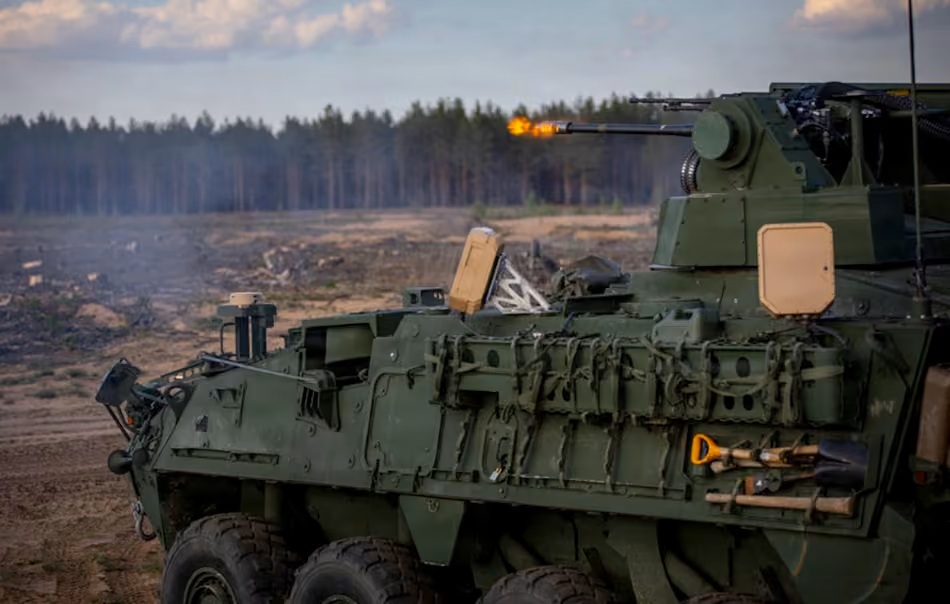
The company’s EchoShield radar, configured for on-the-move (OTM) operation and mounted on a Stryker vehicle, supported testing associated with the U.S. Army’s Short Range Air Defense (SHORAD) programme.
EchoShield delivered critical radar data while both on the move and on-the-halt (OTH). Radar information was seamlessly networked across a combined U.S.-U.K. tactical data architecture, which was tested against a live opposing force in an environment designed to replicate drone and electronic-warfare threats.
A key element of the demonstration was interoperability. EchoShield was rapidly integrated with Anduril’s command-and-control (C2) architecture, enabling high-fidelity C-UAS detection, tracking and classification information to be delivered directly to warfighters.
Echodyne emphasises that the compact dimensions, simplified operation and rapid deployment of its radar systems allow capabilities to be distributed across different military echelons and operated by personnel from a variety of specialist backgrounds. During Flytrap 5.0, these characteristics contributed to layered force protection while supporting offensive manoeuvre in a simulated UAS- and electronic-warfare-saturated battlespace.
“Flytrap 5.0 demonstrated the value of bringing industry and the warfighter together early and often,” said Adam Belmonte, Regional Sales Manager – DoW/IC at Echodyne.
According to Belmonte, direct interaction between technology providers and soldiers enables operational feedback to be incorporated rapidly as emerging capabilities are evaluated and refined.
“We’ve been grateful for the opportunity to work alongside soldiers who are deeply invested in the process and committed to helping identify capabilities that can enhance protection and effectiveness on the battlefield,” he added.
Following the squadron-scale demonstration, Echodyne is scheduled to participate in Flytrap 6.0, where the company intends to demonstrate how its radar capabilities can be scaled further to the brigade level, supporting NATO efforts to strengthen counter-drone effectiveness and battlefield survivability.
 English
  Greek
Greek