


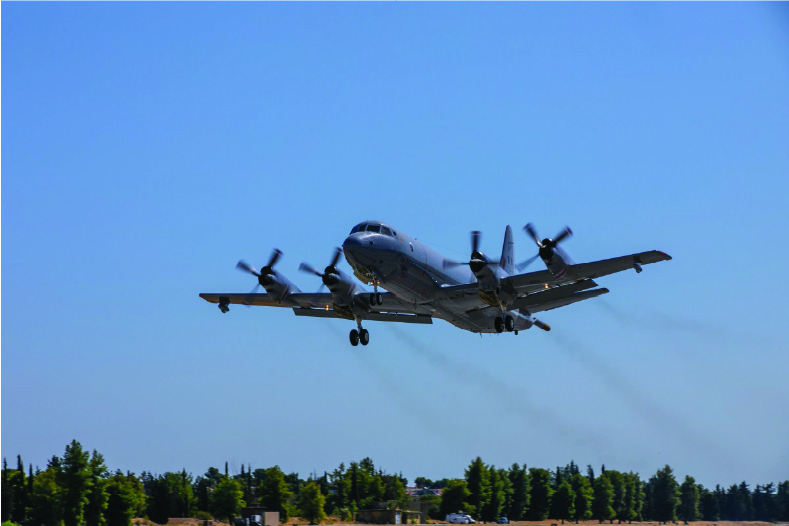
P-3 Orion successfully completed its maiden flight
The Hellenic P-3 Orion modernization program has
recently reached a significant milestone after nearly a
decade of delays and technical setbacks. In early
September, the first upgraded P-3B Orion aircraft
successfully completed its maiden test flight, marking a
long-awaited breakthrough in Greece’s efforts to restore
its maritime patrol and anti-submarine warfare (ASW)
capabilities.
The program began in 2015, when the Greek government,
under the SYRIZA-ANEL coalition, approved a
$499,843,145 contract for the Mid-Life Upgrade (MLU) of
five decommissioned P-3B Orion aircraft. These aircraft
had been out of service since approximately 2009 and
were stored at military facilities in Tanagra and Elefsina.
The modernization contract was awarded to Lockheed
Martin, in cooperation with the Hellenic Aerospace
Industry (HAI), which was tasked with carrying out much
of the physical upgrade work in Greece.
A key goal of the project was to extend the operational life
of the aircraft by at least 15 years, while enhancing
Greece’s intelligence, surveillance, and reconnaissance
(ISR) capabilities in the Aegean and Eastern
Mediterranean. However, the upgrade process faced
severe technical difficulties. Integrating new digital
avionics, mission systems, and communications
equipment into an airframe designed with analog systems
from the 1960s proved far more complex than anticipated.
These analog-to-digital conversions caused numerous
software conflicts, electrical system failures, and
mechanical malfunctions. Combined with chronic
understaffing at HAI, these issues significantly delayed
progress.
Although an initial payment was made shortly after the
contract was signed, and the full amount was eventually
paid, none of the five aircraft had been declared fully
operational by the originally scheduled deadline of 2020.
This situation prompted sharp criticism from defense
analysts and political opposition, who questioned the
program’s cost-effectiveness and feasibility. Critics argue
that the funds could have been more wisely spent on
newer aircraft platforms, rather than reviving aging
airframes that had been grounded for over a decade.
On the other hand, program supporters defend the
investment as strategically valuable. They argue that the
upgraded aircraft will provide Greece with a crucial
capability gap filler in maritime surveillance and ASW,
especially in light of regional tensions. Furthermore,
keeping much of the work in-country has contributed to
the revitalization of the domestic defense sector,
providing jobs and technological expertise.
Due to the delays, cost overruns, and questions
surrounding the program’s justification, the issue has
become the subject of legal and political investigation.
The Supreme Court has forwarded a case file to
Parliament, which is now considering whether to lift
immunity from certain political figures who were involved
in approving the project through the government’s Higher
Council on Defense & Foreign Affairs (KYSEA).
Individuals under scrutiny include former ministers and
high-ranking defense officials.
Despite the challenges, the recent successful test flight of
the first upgraded P-3B has renewed hopes that the
remaining aircraft may soon follow. Industry leaders at
both HAI and Lockheed Martin have expressed
confidence that the project has overcome its most critical
obstacles and will ultimately deliver operationally valuable
platforms to the Hellenic Navy, ensuring long-term
mission readiness.
 English
  Greek
Greek