


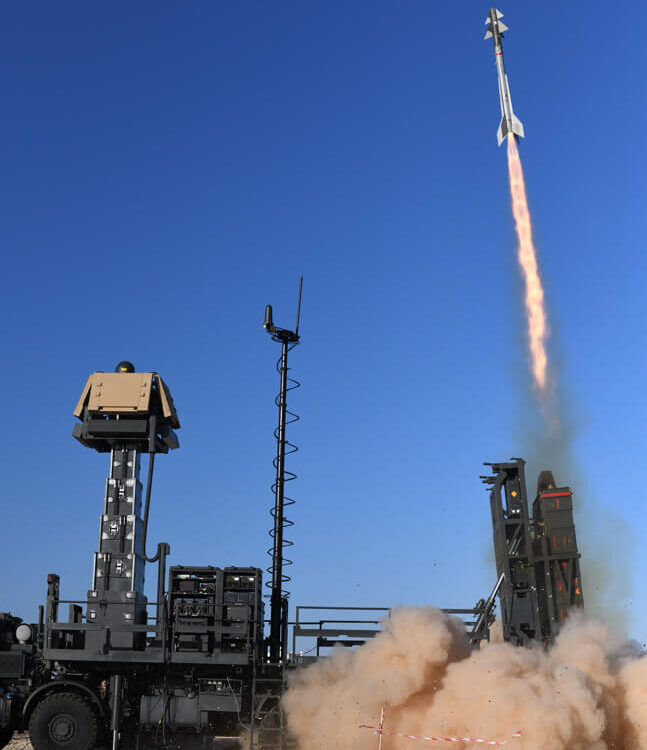
Kenya receives SPYDER air defense systems from Israel
According to JERUSALEM POST Kenya has received the SPYDER air defense system from Israel as part of a KSh 3.4 billion (approximately USD 26 million) procurement designed to boost the country’s military readiness and strengthen protection of its national airspace. The delivery represents an important milestone in the Kenya Defence Forces’ (KDF) ongoing modernization program, which has increasingly focused on acquiring technologically advanced systems capable of countering evolving aerial threats.
roduced by Rafael Advanced Defense Systems and forms part of Israel’s family of layered air and missile defense capabilities. It is designed to intercept a wide range of aerial platforms, including fighter aircraft, helicopters, unmanned aerial vehicles (UAVs), cruise missiles, and precision-guided weapons. Its interceptors are based on the Python-5 and Derby air-to-air missiles, adapted for ground-launch roles, providing rapid reaction capability with high accuracy and reliability.
One of the key advantages of the SPYDER system is its mobility. Mounted on high-mobility vehicles, SPYDER batteries can be rapidly deployed, repositioned, and networked across multiple locations, making the system well-suited to both fixed-site protection and expeditionary operations. The platform integrates radar surveillance, command-and-control nodes, and launcher vehicles to
deliver a fully autonomous, short- to medium-range air defense solution. Depending on configuration, SPYDER variants can provide coverage out to dozens of kilometers, with engagement envelopes tailored to different threat categories.
For Kenya, the introduction of SPYDER marks a significant enhancement of defensive capabilities in a region where both state and non-state actors are increasingly acquiring unmanned systems and stand-off precision weapons. The system will support the protection of key national infrastructure, including airports, energy facilities, government installations, and military bases. It is also expected to enhance the ability of the KDF to secure troop deployments and forward operating locations as part of counter-terror and regional stabilization missions.
The acquisition reflects the strong and longstanding defense and security cooperation between Kenya and Israel, particularly in intelligence sharing, border security, and counterterrorism. Israel remains one of the world’s leading exporters of advanced defense technology, and Kenya’s decision to procure SPYDER places it alongside other global operators of the system, including several NATO and Asian countries.
Kenya has, in recent years, made a series of strategic defence acquisitions, including aircraft, armored vehicles and improved communications technology. These efforts have been driven by persistent regional threats, especially those posed by militant groups operating in Somalia and along the Kenya-Somalia border, as well as the desire to secure major economic corridors and infrastructure projects.
While the KSh 3.4 billion investment represents a substantial financial commitment, defence analysts note that it offers Kenya a significant leap in capability relative to previous air defence assets in the national inventory. The SPYDER system’s quick reaction time, short sensor-to-shooter chain, and high degree of automation contribute to an improved national deterrence posture.
With the delivery now completed, Kenya is expected to focus on training, integration and operational deployment planning. Over time, the introduction of SPYDER could form the foundation of a layered air defence architecture, combining radar surveillance, passive detection systems, and intercept capabilities across multiple ranges.
The acquisition underlines Kenya’s broader ambition to maintain one of East Africa’s most modern and capable armed forces, capable not only of defending national territory but also supporting stability across the wider region.
 Greek
Greek  English