


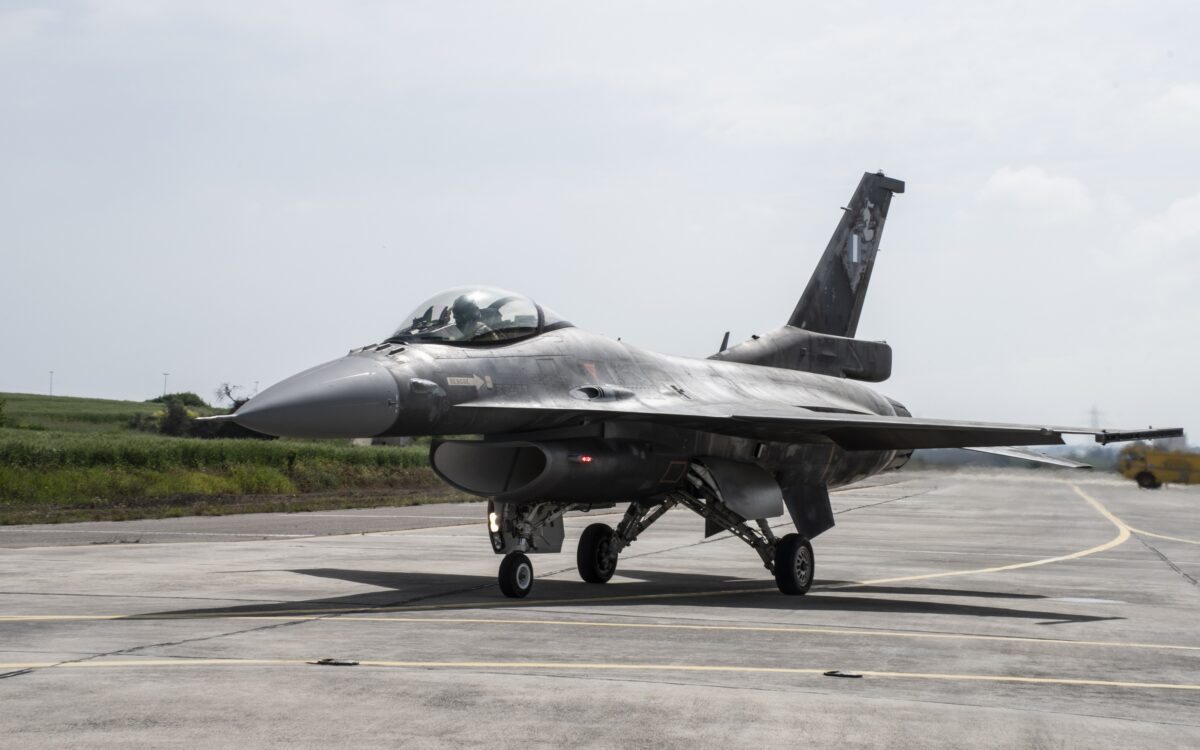
Greece Marks 50th F-16V Delivery as Air Force Modernization Accelerates
Greece has reached another important milestone in the modernization of its air combat capability with the delivery of the 50th F-16V fighter aircraft to the Hellenic Air Force, under the ongoing upgrade programme carried out in cooperation with Lockheed Martin and Hellenic Aerospace Industry (HAI).
The arrival of the 50th upgraded aircraft reflects the steady progress of one of Europe’s most significant fighter modernization efforts, aimed at strengthening the Hellenic Air Force’s operational readiness and long-term combat effectiveness. The transition of the fleet to the advanced Viper configuration is enhancing situational awareness, mission effectiveness and response speed, while giving pilots improved capabilities in increasingly demanding operational environments. These capabilities have already been demonstrated in complex multinational activities such as Exercise INIOCHOS 2026, where upgraded sensors and mission systems supported high-intensity operations alongside allied air forces.
Alexandros Diakopoulos, Executive Chairman of HAI, described the delivery as a major step forward for the programme, underlining that the effort is now advancing at a stable and accelerated pace while generating meaningful operational benefits for the Hellenic Air Force. He stressed that HAI remains committed to completing the programme with consistency and responsibility. Beyond the aircraft deliveries themselves, the programme is also strengthening Greece’s domestic aerospace and defence industrial base. With support from Lockheed Martin, HAI personnel are gaining critical know-how in sustainment, upgrade and modernization work, enabling Greece to support its fleet with greater autonomy.
Mike Shoemaker, Vice President of the Integrated Fighter Group at Lockheed Martin, noted that the focus of the programme extends beyond airborne capability to the long-term foundation required to sustain it, including investment in people, infrastructure and technical skills. The work taking place at Tanagra is therefore not only supporting the modernization of the Hellenic Air Force but also reinforcing Greece’s strategic role within NATO through enhanced national industrial capability and fleet sustainment capacity.
The F-16 upgrade to the Viper (F-16V) standard is a comprehensive modernization program that transforms older F-16 aircraft—such as Greece’s Block 52+ and Advanced variants—into highly capable, 4.5-generation fighters with significantly enhanced combat performance.
At the core of the upgrade is the installation of the AN/APG-83 SABR AESA radar. This is one of the most important improvements, providing substantially greater detection range, the ability to track multiple air and ground targets simultaneously, and strong resistance to electronic jamming. It allows the aircraft to operate effectively in complex and contested environments, particularly in beyond-visual-range engagements. The upgrade also includes a new high-speed modular mission computer and modernized avionics architecture. These systems dramatically improve data processing, enabling faster decision-making and more efficient integration of sensors and weapons.
The open architecture design also ensures that the aircraft can be upgraded more easily in the future. In the cockpit, the aircraft receives a full “glass cockpit” configuration, centered around a large center pedestal display. This replaces older analog instruments and provides the pilot with a much clearer and more comprehensive view of the battlespace, improving situational awareness and reducing workload. Another key feature is enhanced sensor fusion. Data from the radar, targeting pods, and other onboard and offboard sources are combined into a single operational picture, allowing the pilot to understand and react to threats more quickly and effectively.
The aircraft is also equipped with advanced data link capabilities, including Link-16, enabling real-time secure communication and information sharing with other aircraft, airborne early warning platforms, naval units, and ground forces. This allows the F-16V to operate as part of a fully networked force within NATO operations.
A helmet-mounted cueing system is also integrated, allowing the pilot to designate and engage targets simply by looking at them. This significantly enhances close-range combat capability when used in conjunction with modern high off-boresight missiles such as the AIM-9X. Survivability is improved through upgraded electronic warfare systems, including enhanced radar warning receivers and electronic countermeasures, increasing the aircraft’s ability to detect and evade threats in hostile environments. The upgrade supports a wide range of modern weapons, including advanced air-to-air missiles like the AIM-120 AMRAAM, precision-guided munitions such as JDAM and Paveway, and various strike and anti-ship weapons, reinforcing the aircraft’s multirole flexibility.
For the Hellenic Air Force, many upgraded aircraft also retain conformal fuel tanks, which extend operational range without significantly affecting payload capacity. Finally, structural improvements are incorporated to extend the service life of the aircraft, ensuring that the upgraded fleet remains operational and relevant for decades to come. Overall, the F-16V upgrade significantly enhances combat capability, situational awareness, interoperability, and survivability, allowing legacy aircraft to operate effectively in modern, high-threat environments alongside more advanced platforms.
 Greek
Greek  English