


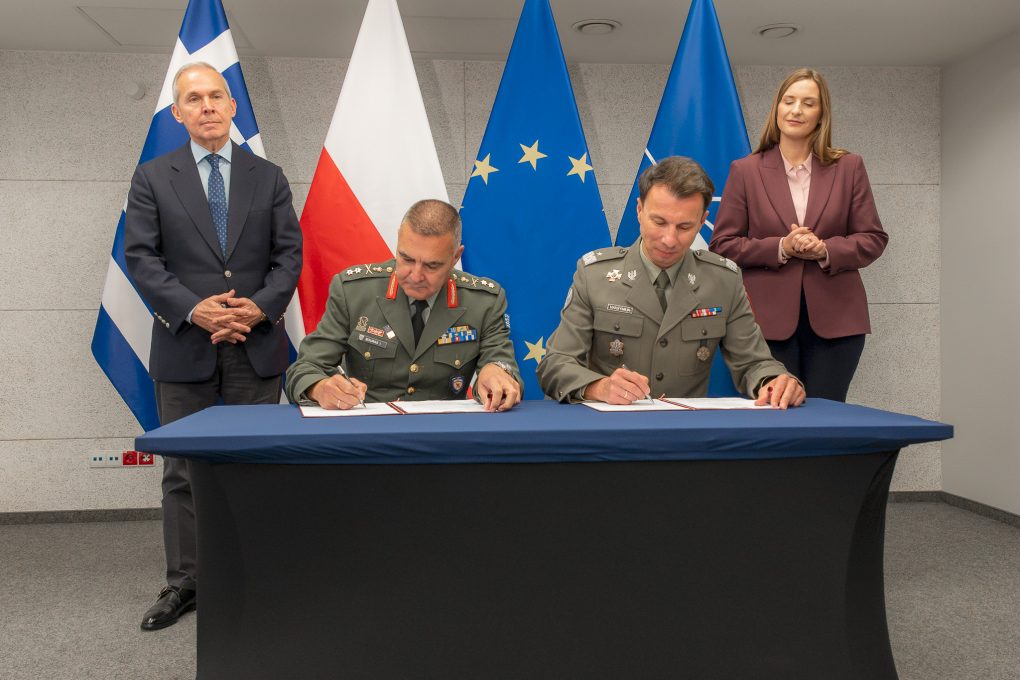
Greece and Poland Strengthen Defence Cooperation with SAR/MikroSAR Satellite Agreement
Greece and Poland have taken a significant step towards strengthening their strategic defence partnership following the successful conclusion of Greek Deputy Minister of National Defence Athanasios Davakis’ official visit to Warsaw on 19 November 2026. The visit culminated in the signing of a Memorandum of Understanding (MoU) concerning Greece’s participation in the SAR/MikroSAR satellite Earth observation programme, within the framework of the European Union’s Security Action for Europe (SAFE) regulation. The agreement represents an important development in bilateral defence cooperation, particularly in the fields of space-based surveillance, advanced technologies, joint procurement and defence industrial collaboration. It also reflects the growing importance of European cooperation in developing strategic capabilities and strengthening technological autonomy in the defence sector.
The SAR/MikroSAR programme focuses on satellite-based Earth observation using Synthetic Aperture Radar (SAR) technology, which enables high-resolution imaging regardless of daylight conditions and through cloud cover. Such capabilities are particularly valuable for military surveillance, intelligence gathering, maritime monitoring and situational awareness. Greece’s participation in the Polish programme is expected to create opportunities for closer technological and industrial cooperation while contributing to the development of advanced space-based capabilities. The signing of the MoU also highlights the potential of the SAFE framework to facilitate collaborative European defence procurement initiatives, particularly in strategically important technological sectors.
During his visit, Davakis held bilateral discussions with Polish Deputy Minister of National Defence Paweł Ksawery Zalewski, responsible for international cooperation. Both sides agreed to substantially expand the number and scope of activities included in their bilateral military cooperation programme for 2027. The discussions reflected a shared commitment to strengthening operational cooperation, expanding military exchanges and developing closer institutional relations between the two countries’ armed forces.
The Greek Deputy Minister also met with his Polish counterpart Magdalena Sobkowiak-Czarnecka, responsible for international financing and defence industry matters. Their discussions addressed the implementation of the joint microsatellite procurement initiative and the establishment of permanent communication and coordination mechanisms between the relevant defence authorities. Particular emphasis was placed on defence industrial cooperation, innovation, joint procurement programmes and coordination regarding European and NATO-related financing instruments. The two sides made substantial progress towards establishing institutional channels intended to ensure continuity and long-term stability in their bilateral industrial partnership.
A major highlight of the visit was the Polish-Greek Defence Industry Forum, organised in Warsaw to promote direct engagement between defence companies from both countries. The event attracted record participation, bringing together 35 Greek and more than 50 Polish companies, alongside representatives of all three Greek institutional associations representing the national defence industry. Davakis and Sobkowiak-Czarnecka jointly addressed the forum, emphasising the importance of expanding industrial partnerships and identifying opportunities for joint technological development, production and investment.
The Greek delegation included Director General of Defence Investments and Armaments Major General Ioannis Bouras, Director of the Hellenic National Defence General Staff’s D Branch Major General Ioannis Korres, Director of its F Branch Major General Georgios Panousis, and a representative of the Hellenic Centre for Defence Innovation.
Commenting on the outcome, Davakis stated that the Greek delegation had achieved all its objectives, including the satellite cooperation agreement, the expansion of bilateral military activities and progress towards permanent institutional coordination. He underlined Poland’s strategic geographical position, mature defence industry and substantial defence expenditure, describing the visit as an important step towards deepening the strategic and industrial relationship between Athens and Warsaw.
The agreements reached in Warsaw signal a broader effort by Greece and Poland to translate their bilateral relationship into concrete defence programmes, reinforcing European industrial cooperation while advancing shared security and technological objectives.
 Greek
 English