


Greece and Britain: Building Defence Cooperation for a Changing Security Landscape
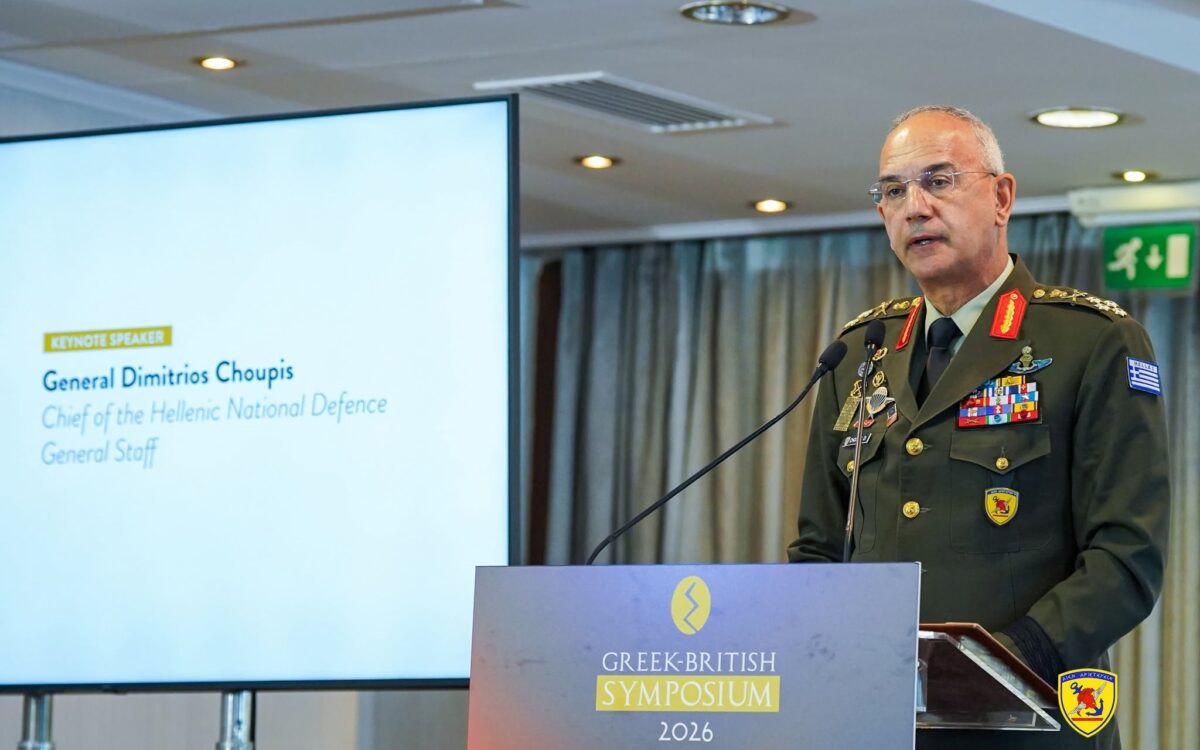
In his opening address to the 10th Greek–British Symposium in 2026, the Chief of the Hellenic National Defence General Staff (HNDGS), General Dimitrios Choupis, outlined shared security challenges and opportunities for closer bilateral defence cooperation. Addressing the audience on the Athens Riviera, he focused on deterrence, technological transformation, energy security, military mobility and the modernisation of the Hellenic Armed Forces under Agenda 2030.
Geography has shaped the strategic outlook of Greece and the United Kingdom for centuries. As maritime nations at opposite ends of Europe, both depend on secure trade routes, reliable energy supplies and access to the seas. These shared interests provide a foundation for cooperation in an increasingly complex security environment.
The return of revisionism, exemplified by Russia’s war against Ukraine, challenges sovereignty and the international legal order. Credible deterrence requires the ability to convince potential aggressors that hostile action will carry unacceptable costs. This demands capabilities across interconnected operational domains, supported by rapid adaptation and informed decision-making.
Information is central to this approach. Satellites, unmanned systems, sensors and open sources generate extensive data, but operational advantage depends on accurate interpretation. Artificial intelligence can shorten the interval between detection, assessment and action without replacing military command. Land, sea, air, space and cyberspace increasingly form a unified operational environment.
Threats also extend beyond conventional warfare. Cyberattacks, sabotage of submarine cables, disinformation and deepfakes exploit the boundaries between peace and conflict. Resilience requires participation across government, industry and society, alongside trusted intelligence exchanges between allies. Collective cybersecurity is consequently an integral component of national deterrence.
Energy security is equally important. Greece’s role as a gateway for liquefied natural gas and regional energy connections creates both strategic advantages and vulnerabilities. Protecting pipelines, terminals, cables and networks safeguards economic stability, while diversified supplies reduce exposure to coercion. Secure infrastructure also supports military readiness and mobility.
Greece’s contribution to allied mobility centres on Alexandroupolis and connections through Bulgaria and Romania towards Moldova and Ukraine. The address identified investment of €3.5 billion across 32 facilities, integrating military installations, transport hubs and industrial capacity for civilian use in peacetime and mobilisation during crises.
Agenda 2030 seeks to transform the Hellenic Armed Forces into a force driven by networks, technology and data. Achilles Shield provides a layered approach to countering aircraft, ballistic missiles, cruise missiles and unmanned vehicles. The Hellenic Centre for Defence Innovation links military requirements with researchers, academies, startups and industry, promoting rapid testing and operational integration of technologies that can mature through use.
Personnel remain fundamental. Education, training, judgement, service conditions and career prospects determine whether technology delivers operational advantage. Defence expenditure must also strengthen industrial capacity, skilled employment, research, exports and civilian applications, linking security with economic development.
For Greece and Britain, deeper cooperation means turning historical ties into practical capabilities through intelligence sharing, joint innovation, exercises, maritime infrastructure protection and academic partnerships. The central challenge is implementation: aligning resources, institutions and sustained commitment before the strategic opportunity narrows further. Success will depend on coordinated action that strengthens military effectiveness, societal resilience and the foundations of shared prosperity.
 Greek
Greek  English