


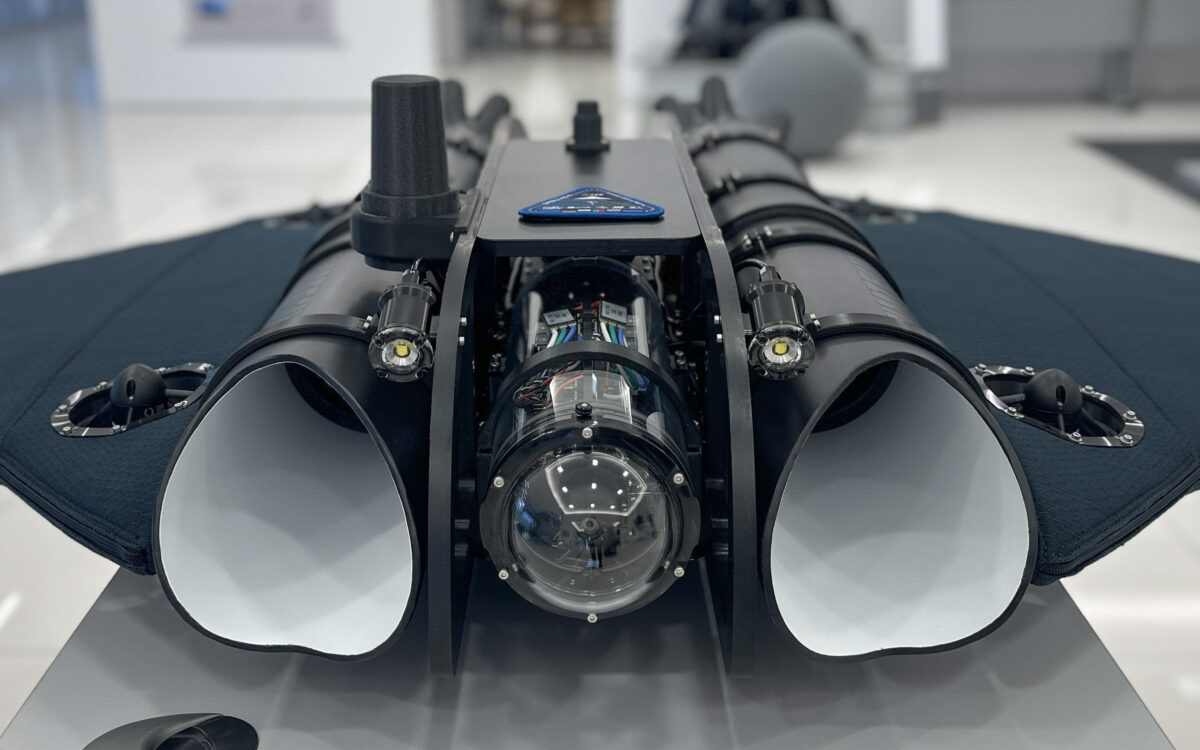
European Defence Agency Project Advances Swarm Technology for Underwater Drones
On 17 February 2026, the European Defence Agency (EDA) announced the conclusion of the second phase of its Swarm of Biomimetic Underwater Vehicles (SABUVIS II) project, marking a significant step toward next-generation naval operations beneath the sea surface.
With a €3.7 million budget and participation from four Member States — Poland (lead nation), Germany, Portugal, and Slovenia — the four-year project focused on enabling autonomous underwater vehicles (AUVs) to operate not as isolated platforms, but as coordinated, intelligent swarms functioning as a unified system.
Overcoming the Challenges of the Underwater Domain
Operating underwater presents unique technological constraints:
- No satellite-based tracking (GPS unavailable)
- Limited communication bandwidth
- High signal latency
- Unpredictable and dynamic environments
SABUVIS II addressed these constraints through advanced autonomy, adaptive communication protocols, and improved command-and-control (C2) integration. Field demonstrations conducted in Poland, Germany, and Portugal — including during REPMUS 2025 — tested mixed drone swarms in realistic operational scenarios. These trials validated swarm coordination, formation control, adaptive mission execution, and interoperability across platforms from different countries and manufacturers.
The project also built upon earlier EDA research, notably the SALSA initiative, which developed adaptive underwater acoustic networking technologies to support reliable multi-platform communication.
From Individual Units to Intelligent Swarms
Unlike traditional AUVs that operate independently, swarm-enabled systems share real-time data, dynamically coordinate tasks, and compensate for unit failures — ensuring mission continuity even if individual vehicles are lost.
SABUVIS II explored three complementary concepts:
- Scalable, cost-effective AUV swarms
- Biomimetic vehicles designed for manoeuvrability in shallow or cluttered littoral waters
- Mixed swarms integrating underwater and autonomous surface vehicles
Beyond hardware development, the project established advanced simulation and testing environments to validate swarm behaviours before deployment.
Strategic Relevance
EDA assesses that swarm-enabled underwater systems will play an important role in future naval missions, including intelligence, surveillance and reconnaissance (ISR), protection of critical maritime infrastructure, harbour security, and high-risk operations in contested environments.
 Greek
Greek  English