


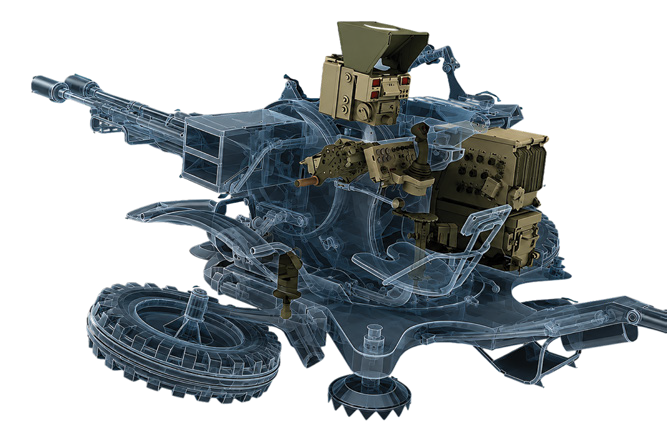
AREX ARM-28: Modernising Anti-Aircraft Artillery for the Counter-Drone Mission
High-intensity conflicts have highlighted the growing threat posed by small unmanned aerial systems and the need for affordable, sustainable countermeasures. As drones became increasingly prominent on the battlefield, armed forces renewed their interest in anti-aircraft artillery and the modernisation of existing inventories. Responding to this requirement, AREX S.A., a member of WB GROUP, proposed upgrading the legacy ZU-23-2 twin-barrelled 23 mm anti-aircraft cannon into an automated, sensor-linked counter-drone system. The ARM-28 upgrade kit, presented with a jammer, demonstrated an approach that combined established artillery with modern technology to address changing operational demands while extending the relevance of existing equipment.
The financial imbalance between inexpensive drones and costly interceptors strengthened the case for alternative engagement options. Surface-to-air missiles remained essential to air defence, but their repeated use against low-cost unmanned aircraft raised questions about affordability and stockpile sustainability. AREX’s modernisation proposal addressed this challenge by retaining the ZU-23-2’s kinetic capability while introducing electro-optical sensors, digital fire control and electric drives. These additions were intended to transform an older artillery design into a more capable counter-UAS asset. The approach offered armed forces a potential means of improving their response to unmanned threats without making every engagement dependent on an expensive missile.
The ARM-28 package also incorporated a jammer, adding an electronic countermeasure component to the artillery upgrade. This combination reflected the importance of complementary responses to drones rather than dependence on a single method of interception. Electronic countermeasures and gun-based engagement represented different approaches, whose usefulness depended on the characteristics of the threat and the operating environment. By presenting both within its upgrade offering, AREX broadened the proposed role of the ZU-23-2 beyond its original configuration. The concept illustrated how established weapon systems could be adapted to contribute to a wider counter-drone capability through the addition of sensing, automation and electronic systems.
For countries that retained ZU-23-2 inventories, the proposal highlighted the potential value of modernisation as part of defence planning. Existing equipment represented an investment that could warrant reassessment before replacement, particularly where upgrades addressed limitations in observation, control and responsiveness. AREX’s approach focused on these areas while preserving the underlying artillery platform. Such programmes offered an opportunity to extend service life and improve operational relevance, although their value depended on customer requirements and the performance of the complete system. Modernisation therefore provided a possible complement to new procurement, helping armed forces balance immediate capability needs with available resources and longer-term priorities.
AREX’s specialisation in automation, control and defence systems underpinned the proposal. Within WB GROUP, the company developed technological solutions for national and international armed forces, applying its engineering expertise to evolving operational requirements. ARM-28 brought that focus to the counter-drone mission, where affordability, adaptability and the effective use of existing assets had become increasingly important considerations. The upgrade demonstrated the continuing relevance of anti-aircraft artillery within discussions about modern force protection. More broadly, it showed how targeted investment in sensors, controls and complementary countermeasures could offer established platforms a renewed purpose as armed forces responded to the changing character of airborne threats.
 Greek
 English