



Greece Deploys Patriot PAC-III and F-16s to Support Bulgaria’s Air Defense
Greek Minister of National Defence Nikos Dendias announced that Greece will provide military support to Bulgaria following a request from Bulgarian Defence Minister Atanas Zapryanov. The decision was approved by Greece’s Government Council for Foreign Affairs and Defence (KYSEA) after consultations between the two governments.
As part of the support package, Greece will deploy a MIM-104 Patriot PAC-III air and missile defence battery to a suitable location in northern Greece. The mobile long-range system, which has been in service with the Hellenic Air Force since 2003, features a radar search range of approximately 170 km and a maximum engagement range of around 150 km. A Patriot battery consists of several key components, including an Information Coordination Center (ICC), Radar Set, Engagement Control Station (ECS) and multiple launching stations. The ECS can control up to 16 launchers, which can be dispersed and remotely operated within a radius of about 30 km.
In addition, a pair of F-16 Fighting Falcon fighter aircraft will redeploy to an air base in northern Greece to provide additional aerial coverage for Bulgaria. To facilitate coordination, two senior officers from the Hellenic Air Force will also be dispatched to the Bulgarian Armed Forces’ operations center in Sofia.
According to Dendias, the deployment does not affect Greece’s own defensive readiness and reflects the strong cooperation between NATO and EU allies.
© Photo credit: Hellenic Air Force
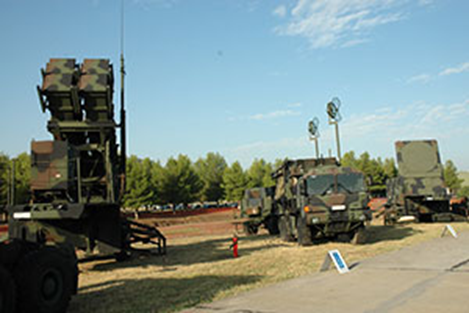
MIM-104 Patriot PAC-III – Characteristics
The Patriot PAC-III (Phased Array Tracking Radar to Intercept on Target) is a mobile long-range surface-to-air missile (SAM) and anti-ballistic missile defence system developed in the United States. It is designed to intercept aircraft, cruise missiles, and tactical ballistic missiles, providing high-precision air and missile defense for large areas.
Main Operational Characteristics
- Origin: United States
- Type: Long-range mobile air and missile defence system
- Operational in Greece: Since 2003 with the Hellenic Air Force
- Primary Role:
- Anti-aircraft defence
- Anti-ballistic missile defence
- Protection of strategic infrastructure and population centers
Radar and Engagement Performance
- Radar type: Phased-array multifunction radar
- Radar search range: approximately 170 km
- Maximum engagement range: up to 150 km (against aerodynamic targets)
- Ballistic missile interception: shorter range but extremely high precision
- Guidance: Track-via-missile guidance and hit-to-kill interception in PAC-III missiles
Battery Structure
A Patriot battery is composed of several key components:
- Information Coordination Center (ICC)
- Coordinates multiple Patriot batteries within the air defence network.
- Radar Set (AN/MPQ-65 or upgraded variants)
- Detects, tracks and identifies targets.
- Provides missile guidance and fire control.
- Engagement Control Station (ECS)
- The command console where operators control the system.
- Manages targeting, tracking and missile launch decisions.
- Launching Stations (Missile Launchers)
- Carry and fire interceptor missiles.
- Each ECS can control up to 16 launchers.
Deployment Characteristics
- Launcher dispersion: up to 30 km radius from the control station
- Mobility: truck-mounted system allowing rapid deployment
- Network integration: compatible with integrated NATO air defence systems
Key Advantage of PAC-III
The PAC-III interceptor uses hit-to-kill technology, meaning it destroys incoming missiles by direct kinetic impact, rather than relying primarily on explosive fragmentation, significantly increasing interception accuracy against ballistic missile threats.
 Greek
Greek  English