


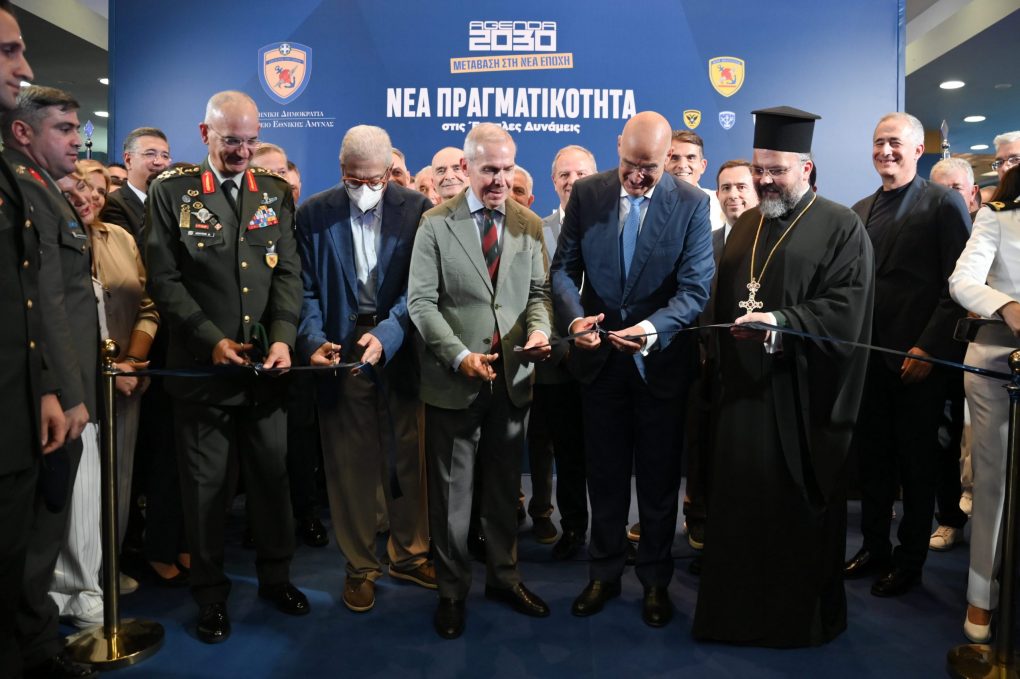
Dendias Unveils “Agenda 2030” Vision for Greece’s Armed Forces at Thessaloniki International Fair
Greek Minister of National Defence Nikos Dendias inaugurated the Ministry of National Defence pavilion at the 90th Thessaloniki International Fair on 5 September 2026, presenting the government’s broad strategic vision for transforming the Hellenic Armed Forces through the “Agenda 2030” reform programme.
The Ministry is participating in this year’s exhibition under the central theme “A New Reality in the Armed Forces.” Dendias was accompanied by Deputy Minister of National Defence Thanasis Davakis, Chief of the Hellenic National Defence General Staff General Dimitrios Choupis, senior Ministry officials and the Chiefs of the three Services.
In his address, Dendias stressed that rapid technological, geopolitical and economic changes require Greece to adapt its defence structures and capabilities. He described Agenda 2030 as a comprehensive framework for guiding the Armed Forces into a new era, combining military modernisation with a different economic approach to defence.
According to the Minister, Greece must gradually move from the concept of “defence expenditure” to that of “defence investment.” The objective is to transform the country from a customer purchasing foreign systems into a co-producer capable of supporting domestic economic growth, increasing exports and reducing dependence on imports.
Dendias identified fiscal discipline, long-term planning and the development of the domestic defence industry as central pillars of the strategy. He highlighted Greece’s first long-term defence procurement programme, designed to provide the Armed Forces and Greek companies with greater visibility regarding future operational requirements and investment priorities.
Since 2023, Greece has signed defence contracts worth approximately €7 billion, of which €1.5 billion is expected to be channelled into the domestic defence industry. The recently contracted national air-defence and counter-drone “Achilles Shield” programme reportedly involves 19 Greek companies, with domestic production valued at €753 million.
The Minister also presented four Greek-developed counter-drone systems: Kentavros, Hyperion, Telemachos and Teucer. An earlier version of Teucer was recently used at Larissa Prison to intercept a drone transporting mobile phones and illegal drugs. Meanwhile, Ministry of Defence facilities are expected to reach an annual production capacity of 15,000 drones by the end of 2026.
Domestic industrial participation is also expanding in major procurement programmes. Dendias noted that the agreement covering Greece’s latest FDI HN frigate was amended so that approximately 25% of its production would be undertaken in Greece.
Agenda 2030 additionally includes measures supporting military personnel. Savings of between €160 million and €180 million are expected from the second phase of the Armed Forces structure reform. The Ministry intends to request that these resources be redistributed through additional salary increases, potentially by mid-2027.
During his visit, Dendias attended the signing of a Memorandum of Understanding between Hellenic Aerospace Industry and Generation 5 Holdings, the business arm of the UAE’s Tawazun. The agreement will explore the establishment of a regional aircraft maintenance, repair and overhaul facility in the United Arab Emirates, potentially supporting platforms including the KC-390 and other regional customers. The two parties aim to conclude a definitive agreement during IDEX 2027.
 English
  Greek
Greek