


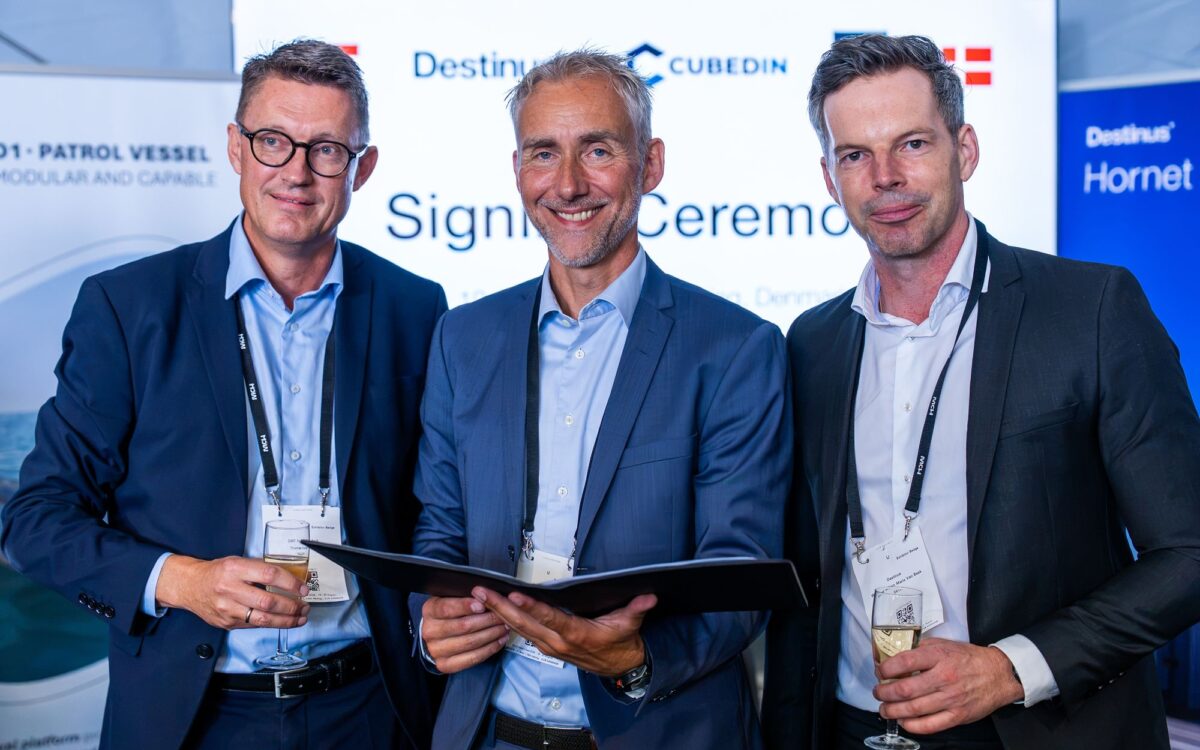
Destinus, CUBEDIN and OMT Join Forces on Modular Naval Hornet Interceptor Capability
Destinus, CUBEDIN A/S and OMT Group A/S have signed a Memorandum of Understanding (MoU) to advance the development of a modular naval counter-UAS capability based on the Destinus Hornet interceptor family.
The cooperation, announced during DALO Industry Days in Herning, Denmark, brings together interceptor technology, naval platform engineering and standardised ship-integration architecture with the objective of creating a containerised solution that can be deployed aboard different classes of naval vessels.
At the centre of the concept is the integration of the Destinus Hornet interceptor family into a 10-ft or 20-ft mission module, providing navies with an additional defensive layer against increasingly numerous and diverse aerial threats.
The proposed architecture is intended to complement existing high-end shipborne air-defence systems. Its emphasis is on providing a scalable response to high-volume threats, including Class 2 unmanned aerial systems (UAS) and related aerial threats.
The proliferation of relatively inexpensive unmanned aerial systems is creating a significant challenge for naval forces. Warships traditionally rely on sophisticated surface-to-air missiles and other high-end defensive systems, but employing expensive interceptors against large numbers of comparatively low-cost drones can create an unfavourable cost-per-engagement equation.
The Hornet-based concept seeks to introduce an additional layer into a ship’s defensive architecture, giving commanders another option for countering such threats while preserving more capable and expensive air-defence weapons for higher-priority targets.
A key element of the programme is modularity. Rather than requiring extensive redesign of a vessel, the partners intend to package the capability within standard 10-ft or 20-ft mission modules. The approach is designed to facilitate installation aboard both existing vessels and future ship classes, subject to the necessary platform-specific engineering, integration and qualification.
The three companies will contribute complementary areas of expertise. Destinus will provide the Hornet interceptor system and mission module, while OMT Group will contribute naval platform engineering and maritime design expertise. CUBEDIN will provide the standardised interfaces and integration architecture required to connect the capability with different naval platforms.
Each partner will also support concept development, design reviews and qualification activities within its respective area of responsibility.
“Navies need more defence and deterrence capacity against threats that keep multiplying, without spending a high-end missile on every engagement,” said Wouter van Beek, Chief Commercial Officer at Destinus. “A modular mission architecture is a practical way to bring Hornet aboard different vessel classes without redesigning the ship around it.”
Kåre Groes Christiansen, CEO of OMT Group A/S, highlighted the growing importance of modularity and adaptability for future naval capabilities, noting that combining interceptor technology with naval platform engineering and standardised interfaces could allow navies to introduce new defensive capabilities without waiting for an entirely new ship class.
CUBEDIN’s role focuses particularly on the integration challenge associated with introducing new effectors aboard operational naval platforms.
“Advanced effectors do not become operational capability on their own. They have to be integrated safely and efficiently into the platform,” said Danny Ingemann, CEO of CUBEDIN A/S. “Together with Destinus and OMT, we are building a standardised integration approach that shortens the path from concept to capability at sea.”
The envisaged development programme will progress through a series of engineering and qualification milestones, including preliminary design review, critical design review and final qualification.
The three companies also intend to pursue opportunities with European navies as maritime forces increasingly reassess their air-defence and counter-UAS requirements in response to the rapid proliferation and growing sophistication of unmanned aerial threats.
If successfully developed and qualified, the containerised Hornet concept could provide naval forces with a flexible means of adding counter-UAS capacity to existing and future fleets while retaining the ability to adapt and reconfigure the capability as operational requirements evolve.
 English
  Greek
Greek