


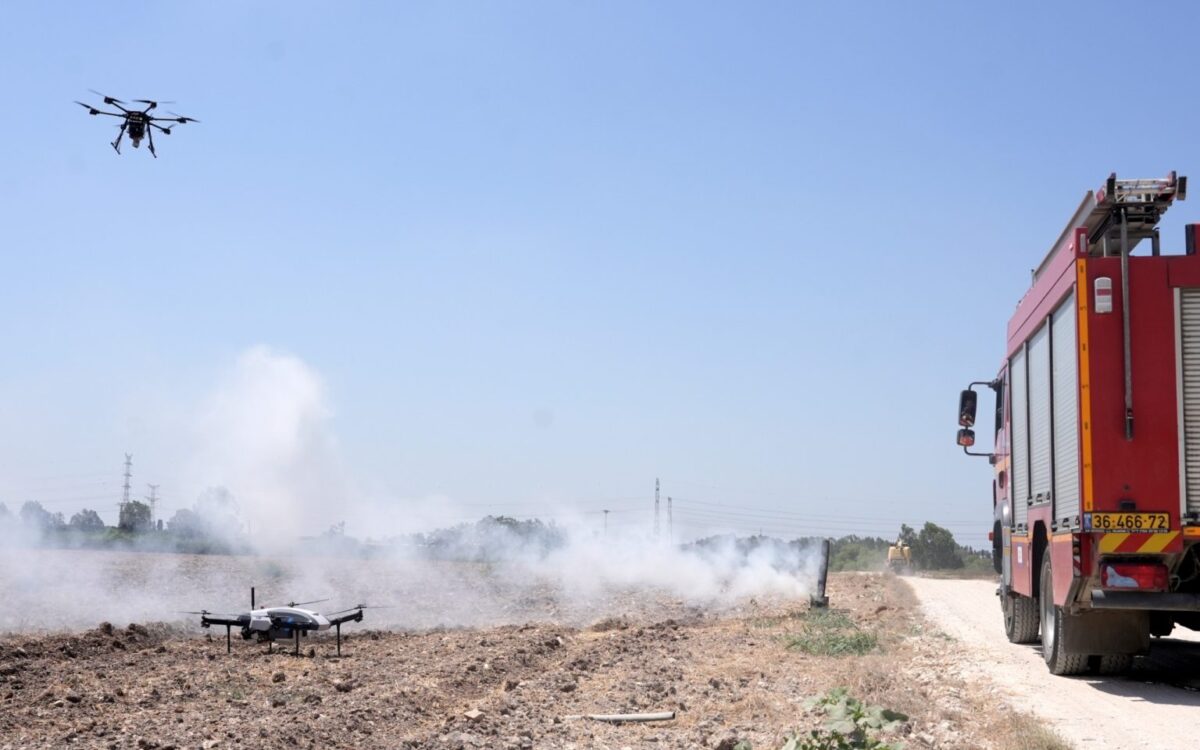
Israel Develops AI-Powered Drone System for Early Wildfire Detection
Israel has launched a joint national programme to develop an advanced artificial intelligence (AI)-enabled drone system capable of detecting and accurately locating wildfires within minutes of ignition, significantly improving emergency response times and helping prevent small fires from escalating into large-scale disasters.
The initiative brings together the Ministry of National Security, the Israel Innovation Authority, Israel Aerospace Industries (IAI), the Technion – Israel Institute of Technology, and the Israel Fire and Rescue Authority. The programme has already achieved an important milestone with the successful completion of its first flight test, marking the beginning of an extensive evaluation campaign under a variety of operational and environmental conditions.
At the heart of the system is IAI’s APUS 25 tactical Vertical Take-Off and Landing (VTOL) unmanned aerial vehicle, a long-endurance platform capable of operating without a runway from virtually any location. Designed for persistent surveillance missions, the APUS 25 is powered by an internal combustion engine, enabling significantly longer endurance than comparable battery-powered drones and allowing continuous operations for up to five hours.
The aircraft carries a dedicated sensor suite combining electro-optical day cameras, thermal imaging and infrared sensors capable of detecting fire hotspots during both daylight and nighttime operations, even through dense smoke. Advanced spectral image-processing algorithms, supported by artificial intelligence, analyse sensor data in real time to identify anomalies associated with emerging fires.
Once a fire is detected, the system automatically determines its precise geographic location with metre-level accuracy and immediately transmits an alert directly to the Israel Fire and Rescue Authority’s command-and-control centre, enabling emergency services to respond while the fire is still in its earliest stages.
According to the programme partners, a single APUS 25 can monitor hundreds of square kilometres, providing continuous surveillance of large forests, remote terrain and other high-risk areas. The combination of persistent airborne monitoring and AI-driven analysis is intended to significantly improve situational awareness and reduce response times during increasingly frequent wildfire events linked to climate change.
The drone will be operated by fire service personnel through a simple mission-planning interface. Operators define the surveillance area by selecting a polygon on a digital map, after which the aircraft autonomously flies to the designated area, positions itself at the optimum observation point and continuously scans the assigned sector while transmitting real-time operational data to emergency responders.
The project reflects Israel’s broader strategy of integrating autonomous systems and artificial intelligence into civilian emergency response capabilities. By combining IAI’s expertise in unmanned aviation with the Technion’s advanced AI algorithms and the operational experience of the Israel Fire and Rescue Authority, the programme aims to create a next-generation wildfire detection capability capable of protecting lives, infrastructure and natural resources.
Following the successful initial flight trial, the partners will continue a series of operational tests designed to validate the system under diverse environmental conditions before its potential introduction into operational service.
 English
  Greek
Greek