


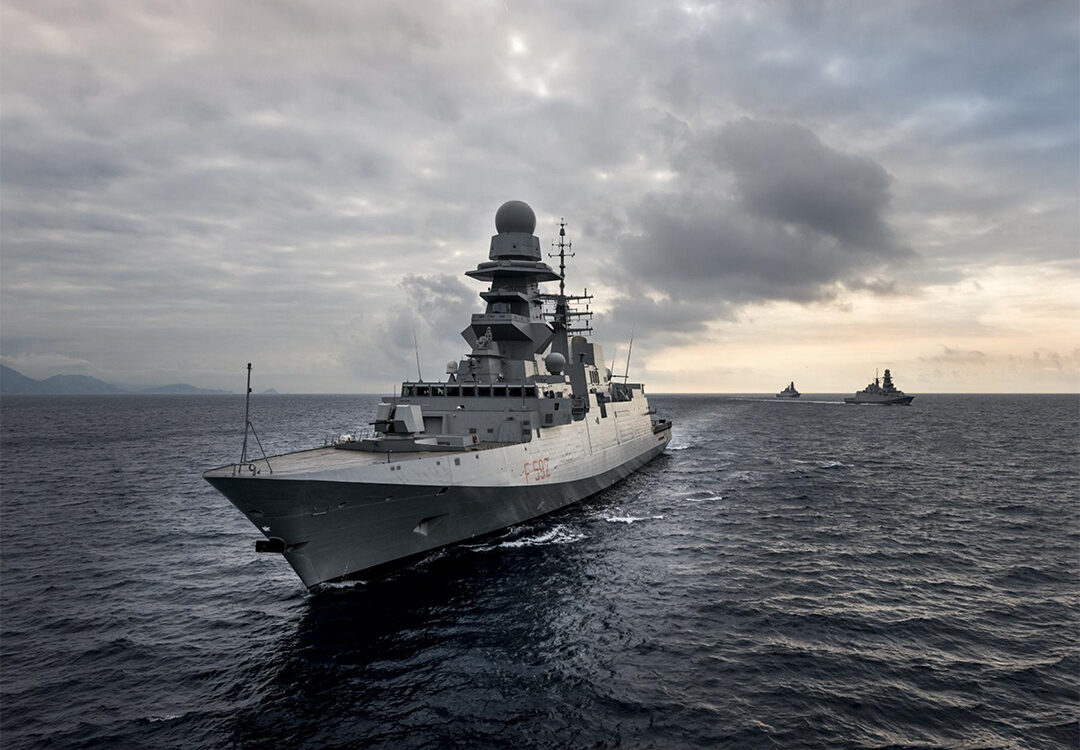
Greece Signs MoU with Italy for Bergamini-class FREMM Frigates
Greece and Italy have taken a significant step toward
enhancing their defence cooperation with the signing of a
Memorandum of Understanding (MoU) and a Declaration of
Intent concerning the potential acquisition of 2+2 FREMMBergamini-class frigates by the Hellenic Navy. The
agreement was signed on September 29, 2025, during the
opening of the SEAFUTURE exhibition in La Spezia, Italy.
The ceremony took place aboard the Italian Navy’s FREMM
frigate ITS Spartaco Schergat (F598), with the latest ship of
the class, Emilio Bianchi (F599), present nearby. Greek
Minister of National Defence Nikos Dendias, accompanied by
the Chief of the Hellenic Navy General Staff, Vice Admiral
Dimitrios-Eleftherios Kataras, led the Greek delegation. On
the Italian side, Minister of Defence Guido Crosetto and the
Chief of the Italian Navy, Admiral Enrico Credendino, were
present, underscoring the high-level nature of the event. The
MoU does not constitute a binding procurement contract but
represents the formal beginning of negotiations, allowing
Greece to pursue the acquisition of two Italian FREMMs
initially, with the potential for two more once released from
Italian service. The move aligns closely with Greece’s
Agenda 2030 defence modernization framework, which
seeks to rapidly close capability gaps resulting from years of
austerity following the financial crisis. Greece’s goal is to build
the most modern and powerful navy in its history, according
to statements made by Minister Dendias.
At the center of the discussions is the Bergamini-class
FREMM frigate, the Italian variant of the joint Franco-Italian
FREMM (Fregata Europea Multi-Missione) program. The
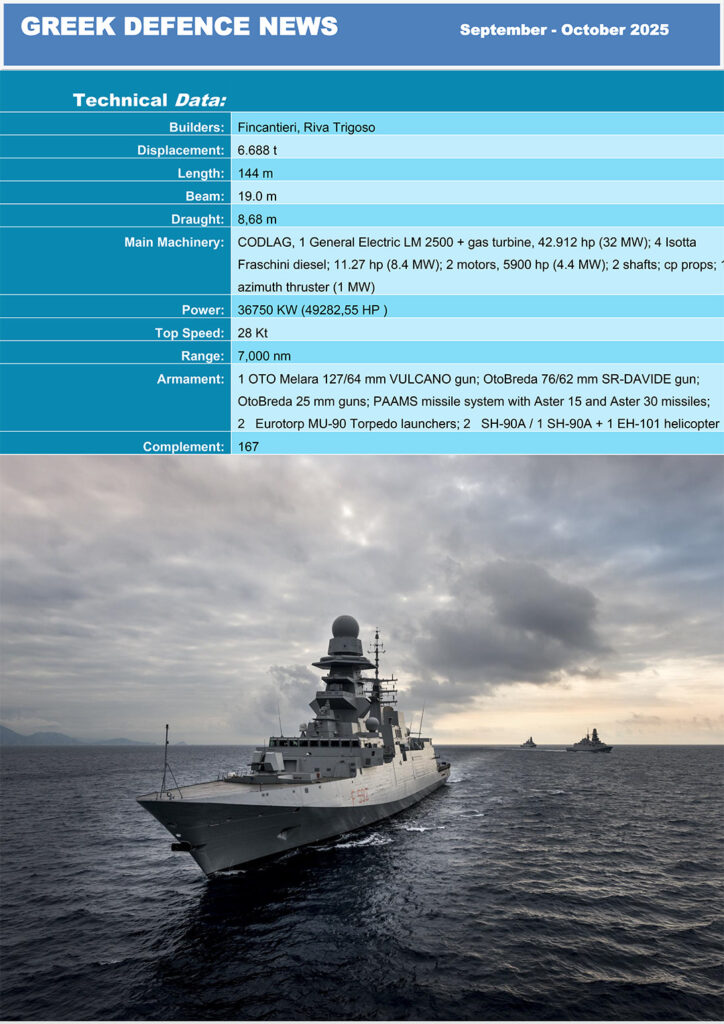
FREMM is a 6,700-ton multi-role frigate, capable of
conducting air defense, anti-submarine warfare, and land
attack missions. Designed with stealth features, modular
systems, and powerful sensors, the general-purpose variant
under consideration by Greece is equipped with the Leonardo
Kronos radar, a 16-cell Sylver A50 vertical launch system for
ASTER 15/30 missiles, a 127mm OTO Melara main gun,
torpedo launchers, and comprehensive electronic warfare
capability. The ships are fully interoperable within NATO and
are already in service with several countries, including
France, Italy, Egypt, and Morocco. Greece’s potential
acquisition would mark its first major surface combatant
purchase from Italy and only the second Italian naval platform
to enter Hellenic service since the replenishment oiler
Prometheus (Etna-class) in the early 2000s.
The MoU signing comes after months of behind-the-scenes
technical evaluations conducted by the Hellenic Navy. Earlier
this year, Greek naval officers inspected the FREMM frigate
Carlo Margottini (F592) during its visit to Piraeus in March,
and more recently the lead ship Carlo Bergamini. An
inspection of Virginio Fasan (F591), the second-oldest ship in
the class, is also expected soon. These evaluations are
focused on assessing the ships’ condition, maintenance
requirements, and modernization potential. Greece is
considering integrating its next-generation ELSA long-range
missiles onto the FREMMs, creating a common armament
base with the FDI HN frigates currently being built in France.
Dendias emphasized that these FREMMs, while a decade
old, remain in excellent condition and offer a cost-effective
way to rapidly strengthen the fleet.
The potential FREMM deal is meant to complement the
acquisition of four French-designed FDI HN (Kimon-class)
frigates, the first of which, Kimon, began sea trials off the
coast of Brittany in July 2025. If fully realized, the FREMM
acquisition would bring the total number of modern frontline
frigates in Greek service to eight by the early 2030s. These
ships would carry between 168 and 192 ASTER 30 missiles,
depending on final VLS loadouts. Alongside the planned
modernization of four Hydra-class (MEKO 200HN) frigates,
the Hellenic Navy would operate a formidable surface fleet
capable of power projection, area air defense, and antisubmarine warfare, reinforcing Greece’s deterrence posture
in the Eastern Mediterranean and Aegean Sea.
For Italy, the prospective transfer offers multiple strategic
benefits. It strengthens defence-industrial ties with a key EU
and NATO ally, supports regional maritime security, and
allows the Italian Navy to accelerate the transition to its future
fleet. The FREMMs sold to Greece would be replaced by the
next-generation FREMM EVO frigates, which are expected to
feature enhanced sensors, automation, and missile
capabilities. Italian shipbuilder Fincantieri, which led the
FREMM construction program, would play a central role in
both the ship transfer and any customization or upgrades
requested by the Hellenic Navy. The FREMM EVO program
itself is part of Italy’s broader naval renewal, and the sale to
Greece would help sustain domestic shipbuilding capacity
during the transition period. The broader strategic context of
the deal cannot be ignored. As tensions continue in the
Eastern Mediterranean, both Greece and Italy are seeking to
expand their naval influence, secure sea lanes, and project
stability in their maritime domains. The FREMM frigates are
particularly well-suited for such missions due to their
operational flexibility and interoperability with allied navies.
The fact that the MoU signed aboard an operational warship,
during an international naval exhibition, underscores the
intent of both governments to signal strength, readiness, and
cohesion.
Addressing the Greek Parliament’s Committee on National
Defence and Foreign Affairs prior to his departure for Italy,
Dendias made clear that this MoU was not just symbolic.
“This is not yet a procurement decision,” he said, “but a major
diplomatic and operational step forward.” He added, “If we
succeed in finalizing this deal, it will be a tremendous success
for our country. We will possess the most capable surface
fleet we have ever had.” The political momentum behind the
initiative is strong, as is the support from the Hellenic Navy’s
leadership.
Looking ahead, both parties will engage in further technical
and contractual negotiations to finalize the potential
purchase. Issues to be addressed include maintenance
support, training, armament integration, and delivery
timelines. While the timeline remains fluid, officials suggest
that a contract for the first two frigates could be concluded
within months, with delivery starting as early as 2026.
In summary, the FREMM MoU between Greece and Italy
marks a key milestone in Mediterranean naval relations. It
aligns the strategic interests of two NATO allies, supports
domestic defence industries, and helps Greece rapidly
modernize its surface fleet. If finalized, the deal will equip the
Hellenic Navy with a powerful set of warships at a time of
growing regional instability and shifting maritime balances.
For both nations, it represents a shared commitment to
security, cooperation, and operational excellence at
 English
  Greek
Greek