


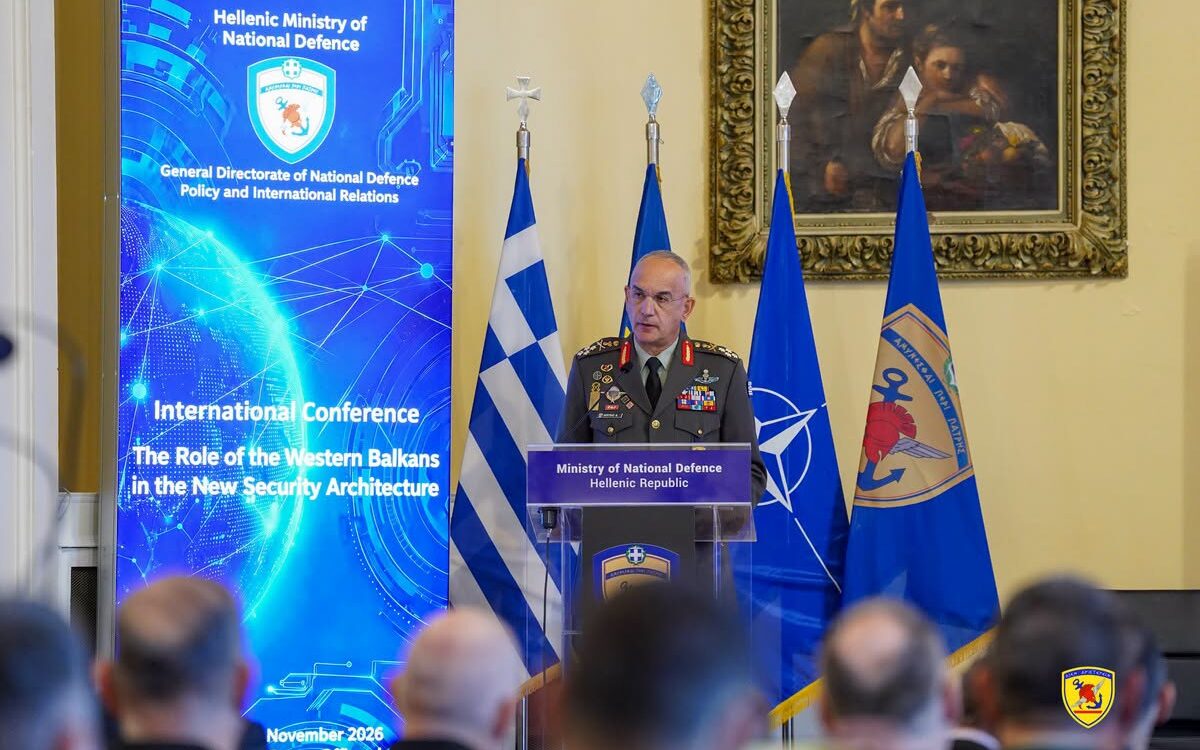
The Role of the Western Balkans in the New Security Architecture
by General Dimitrios Houpis, Chief of the Hellenic National Defence General Staff
The strategic importance of the Western Balkans, the growing challenge of hybrid threats and the relationship between regional stability and European integration were central to an address by General Dimitrios Houpis, Chief of the Hellenic National Defence General Staff. He was speaking at the opening of a conference on the role of the Western Balkans in the new security architecture, organised by the General Directorate of National Defence Policy and International Relations (GDNDPIR) of the Ministry of National Defence. The conference aimed to provide a platform for constructive dialogue and substantive exchanges of views on the region’s strategic importance within the evolving European security architecture. Particular emphasis was placed on its geopolitical significance, the challenges posed by hybrid threats and revisionist ambitions, and the role of European integration as a cornerstone of regional stability and security.
“It is a distinct honour to open the proceedings of this Conference. I wish to express my appreciation to the Directorate General of National Defence Policy and International Relations, and to Ambassador Emeritus Spinellis personally, for an initiative of genuine strategic value. Allow me to begin with a principle long established in strategic thought: no nation can escape the consequences of its position on the map.
Geography defines the threats it must confront, the partners it must seek, and the responsibilities it must bear. In few places is that truer than in the Western Balkans. It is not the periphery of European security, but rather an integral part of it. Yet, position alone guarantees nothing. It must be turned into capability, and capability into stability.
Security is not a static condition; it is a perpetual process of adaptation. We are living through the return of Revisionism, and Russia’s war against Ukraine is its starkest expression: an attempt to redraw borders by force on European soil. The new European security architecture is being shaped by this reality, as Europe assumes greater responsibility for its own defence while preserving the transatlantic bond.
That architecture rests on three mutually reinforcing foundations. The first is NATO, which remains the cornerstone of collective defence, and whose Allies committed at The Hague in 2025 to invest 5 per cent of GDP in defence and security by 2035.
The second is a stronger European pillar, complementary to the Alliance and guided by the Strategic Compass and the Readiness 2030 agenda: an industrial base capable of producing at scale, secure supply chains, and the military mobility on which deterrence depends. Instruments such as SAFE now give that ambition financial substance. Its framework is the Union’s Common Foreign and Security Policy and, within it, the Common Security and Defence Policy, of which Operation Althea is a tangible expression.
The third is the enlargement of the Union itself: the admission of new Member States once they have met the criteria for membership. Those conditions, established at Copenhagen in 1993, are demanding, and rightly so: stable institutions guaranteeing democracy, the rule of law, human rights and the protection of minorities; a functioning market economy; and the capacity to assume the obligations of membership. To these must be added good-neighbourly relations and the Union’s own capacity to absorb new members.
The geopolitical environment has not altered these conditions, but it has altered their urgency. Since Russia’s invasion of Ukraine, enlargement has once again become a strategic choice, extending the area of shared rules, institutions, and commitments. As the European Parliament declared this March, enlargement “strengthens EU security and prevents destabilising geopolitical grey zones”. Delay now carries a cost: where the European perspective loses credibility, external actors find room for influence. Alignment with the Common Foreign and Security Policy has thus become a key measure of a candidate’s strategic orientation.
The implications are direct. For the region, reform is itself a security measure, given that strong institutions and the rule of law remove the very vulnerabilities that hybrid threats exploit. The Growth Plan for the Western Balkans, worth 6 billion euros for 2024 to 2027, already ties the benefits of integration to completed reforms. For the Union, credibility demands that commitments be honoured and that its own institutions be prepared. For our armed forces, interoperability and common standards can advance ahead of the political process, and prepare the ground for it. The Western Balkans are therefore no longer a question of Europe’s external relations, but of its internal security. An architecture so conceived cannot be complete while an area of uncertainty remains at its centre.
I would offer three observations on the military dimension of regional security.
First, the risk of large-scale conventional conflict in the region remains low, yet this is no ground for complacency. The Western Balkans live in a condition of unstable stability, caught between nostalgia for the past and uncertainty about the future, where a local incident can still become a crisis. The credible presence of capable forces, clear lines of communication between Commands and constant situational awareness prevent miscalculation from becoming escalation. Deterrence is not provocation; it is a precondition of peace.
Second, while large-scale conflict remains unlikely, hybrid threats and cyber warfare have become markedly more common, and they now constitute the principal challenge. They operate below the threshold of war, with no front line and no ceasefire. Russia, together with other state and non-state actors, exploits political and ethnic divisions in the region through disinformation, cyber activity and political influence, seeking to obstruct its European and Euro-Atlantic course. These efforts find fertile ground in organised crime, corruption, extremism, and demographic decline. Their aim is to erode trust in institutions and to shape human perception itself. And Revisionism, wherever it originates, treats treaties as provisional and sovereignty as negotiable.
Our response must be whole-of-society, built on what we call hybrid immunisation: the capacity to diagnose early and respond together. Within this effort, the armed forces protect their command and communication networks, safeguard critical infrastructure in support of civil authorities, preserve the cohesion of their personnel against manipulation, and share information with partners quickly and reliably. It is not enough to know first; we must also know accurately. Our task is to produce intelligence, not opinion.
Third, no country, however powerful, can face these challenges alone. It follows that defence cooperation is not a supplement to national defence. It is one of its conditions.
Regional security cooperation is, nevertheless, shaped by a number of factors: the malign influence of third powers and the extent to which the countries of the Western Balkans align with the Union’s Common Foreign and Security Policy; the lack of reconciliation among the peoples of the region, owing to a troubled past; and political extremism and ethnic radicalisation. Each of these limits the trust on which military cooperation depends. Frameworks such as the Regional Cooperation Council in Sarajevo (established in 2008) exist to help overcome them.
Operation Althea offers the clearest evidence of what such cooperation can achieve. Since 2004, under the Berlin Plus arrangements between the European Union and NATO, it has supported a safe and secure environment in Bosnia and Herzegovina. On 30 October, the United Nations Security Council unanimously renewed its authorisation for a further twelve months through Resolution 2834.
The credibility of a partner is not a matter of declaration; it is proven in practice. Within Althea, Greece commanded the Multinational Task Force North as Framework Nation in 2006 and 2007. The lesson is of wider application: presence must be credible, cooperation inclusive, and the ultimate aim local ownership.
Above all, our common work must invest in people. Professional military education gives future commanders a common language and lasting bonds. Equipment may be procured; the judgement of a commander can only be cultivated over their career.
The assessment of each candidate’s progress rests with the Union’s institutions and its Member States, not with the military. The strategic logic, however, is plain: security provides the time and space in which reform can take root; European integration gives it direction and durability. For this reason, Greece has supported the region’s European perspective since the Thessaloniki Agenda of 2003, a commitment renewed this April by the Delphi Declaration, and high on the agenda of our Presidency of the Council in 2027. For Greece, enlargement is an irreversible course and an investment in stability.
Regional stability and European integration are not parallel paths. They are one and the same strategic undertaking.
Ladies and Gentlemen,
I would define the role of the Western Balkans in the new security architecture as threefold: The region is a strategic link, connecting Central Europe with the Adriatic, the Aegean, and the Eastern Mediterranean; its corridors, ports, and airspace form part of the strategic depth of the continent. It is a test of credibility for Europe’s ability to secure its own continent and to honour its commitments, which will be judged here. Finally, the Western Balkans must become a contributor to security, no longer merely a recipient of it: a region whose own institutions and armed forces generate stability, as a full and responsible part of the European family.
Thucydides gave Revisionism its creed in the Melian Dialogue: the strong do what they can, and the weak suffer what they must. A security architecture worthy of the name exists to refuse that sentence. In the Western Balkans, that refusal takes the form of steady presence, patient cooperation, and a credible European future. The geopolitical window is open, but narrowing, and in my institutional capacity as Chief of the Hellenic National Defence General Staff, I can safely posit that hope is not a strategy. What is required is the sustained will to act together.
The Hellenic Armed Forces stand ready to continue contributing to this effort, as a responsible Ally, a committed European partner, and a neighbour with an enduring stake in the stability of the region.
I wish every success to the proceedings of this Conference.
Thank you!”
 Greek
 English