


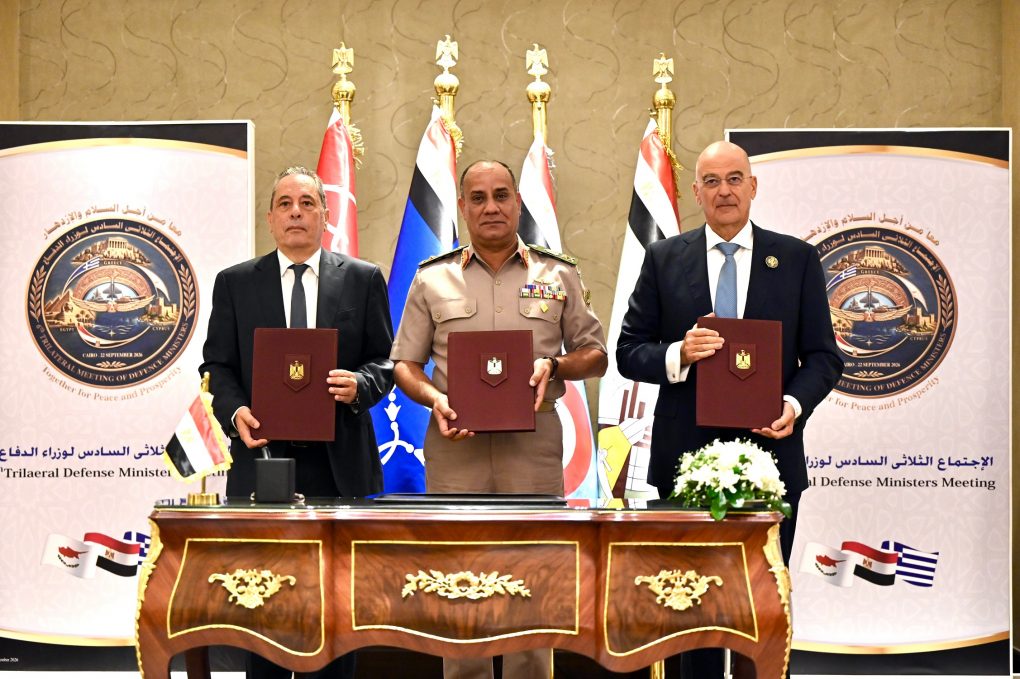
Greece, Egypt and Cyprus Strengthen Trilateral Defence Cooperation in Cairo
Greek Minister of National Defence Nikos Dendias visited Cairo on 22 September 2026 for high-level talks aimed at strengthening defence cooperation between Greece, Egypt and Cyprus. At the beginning of his visit, Dendias was received by Egyptian President Abdel Fattah El-Sisi at Al-Ittihadiya Palace. The Greek minister conveyed the greetings of Prime Minister Kyriakos Mitsotakis and highlighted the broad and longstanding historical relationship between Greece and Egypt. He also reaffirmed Athens’ commitment to close coordination with Cairo in addressing common challenges. The meeting was attended by Egypt’s Minister of Defence and Military Production and Commander-in-Chief of the Armed Forces, General Ashraf Salem Zaher, as well as Major General Mohamed Adly Abdel Wahid Soliman, head of the Egyptian Armed Forces Armament Authority.
Dendias subsequently took part in a trilateral meeting with General Zaher and Cypriot Defence Minister Vasilis Palmas. The talks focused on expanding cooperation among the armed forces of the three countries, including joint military exercises, training activities and measures to improve operational interoperability. The ministers also examined opportunities for collaboration in emerging technologies and defence innovation, while exchanging assessments of the security challenges affecting the Eastern Mediterranean and the wider region. The meeting concluded with the signing of a joint declaration outlining the three countries’ shared objectives and confirming their intention to deepen practical defence cooperation.
Following the meeting, Dendias described the talks as another important step in strengthening relations among Greece, Egypt and Cyprus. He noted that the defence ministers’ meeting followed the recent trilateral summit held in El Alamein and reflected the steady development of cooperation at both political and military levels. The Greek minister characterised Egypt as a strategic and indispensable partner for Greece and Cyprus, while emphasising that their cooperation is not directed against any third country. According to Dendias, the relationship is founded on mutual sincerity, respect for international law and adherence to the United Nations Convention on the Law of the Sea. He also referred to the maritime delimitation agreement between Greece and Egypt, which he signed during his previous tenure as foreign minister alongside his former Egyptian counterpart Sameh Shoukry.
The trilateral discussions were followed by separate bilateral meetings between Dendias and his Egyptian and Cypriot counterparts. During his talks with General Zaher, the two ministers discussed ways to further develop the strategic defence relationship between Greece and Egypt, as well as the evolving security situation in the Eastern Mediterranean and neighbouring regions. In his meeting with Palmas, Dendias reviewed prospects for deepening bilateral defence cooperation between Greece and Cyprus. The visit underlined the growing importance of the Greece-Egypt-Cyprus partnership as a framework for regional consultation, military coordination and stability. Dendias was accompanied in Cairo by Greece’s ambassador to Egypt, Nikolaos Papageorgiou, and Major General Ioannis Korres, director of the Fourth Branch of the Hellenic National Defence General Staff.
The full text of the declaration is as follows:
- LT. General Ashraf Salem Zaher, Commander-in-Chief of the Armed Forces, Minister of Defense and Military Production of the Arab Republic of Egypt Mr. Vasilios Palmas, Minister of Defense of the Republic of Cyprus and Mr. Nikolaos Dendias, Minister of National Defense of the Hellenic Republic; met in Cairo on (September 22, 2026), within the framework of the trilateral dialogue mechanism among the defense ministers of the three countries, aimed at developing joint military cooperation relations.
- The Ministers reviewed developments in the regional security environment, threats arising from armed conflicts, and respective assessments and visions in this regard. They emphasized continuing efforts to develop military coordination and cooperation among the armed forces of the three countries and working jointly to enhance security and stability in the Eastern Mediterranean region to counter threats, thereby supporting regional development efforts.
- Views aligned on the importance of strengthening joint protection frameworks for supply lines, gas fields, and offshore energy infrastructure in the Eastern Mediterranean against various threats, particularly in light of recent circumstances surrounding the region.
- The three parties affirmed that this cooperation mechanism serves as a pillar for regional stability based on openness, commitment to good neighborliness, and safeguarding regional security within the framework of adherence to the United Nations Charter, the UN Convention on the Law of the Sea (UNCLOS), other relevant agreements, rules of international law, and the principles of respecting state sovereignty, territorial integrity, and non-interference in internal affairs, free from international/regional competition and polarization.
- The Defense Ministers of the three countries expressed the need to intensify efforts and coordinate positions to confront transboundary security challenges/threats, foremost of which are counterterrorism, combating all forms of smuggling, irregular migration, human trafficking, and organized crime, in addition to securing maritime navigation – imposing further responsibilities for coordination and cooperation to face these challenges.
- The Ministers praised the results achieved by the forces participating in the joint military exercises, foremost of which is Exercise “Medusa”, which contributes to enhancing operational coordination and combat readiness to deter all forms of shared threats.
- They also emphasized the importance and collective responsibility of the international community to cooperate in de-escalating current tensions in the region, the necessity of an immediate cessation of armed conflicts, and resolving crises through political means – avoiding the expansion of conflict and geographically and temporally extended confrontations that harm the entire world. They reaffirmed the commitment of the three countries to maintaining constructive dialogue with all concerned parties to serve regional security and stability.
- In this context, it was agreed to:
-
- The importance to strengthening military and defense cooperation frameworks to support the collective capacity for a rapid and unified response to any future developments regarding threat sources of all kinds against the three countries.
-
- Intensify communication, consultation, and exchanged information and assessment, as well as coordinate joint capabilities in a manner commensurate with the gravity of current and future military and security threats and challenges at the regional level.
-
- Hold the next meeting of the dialogue mechanism of the defense ministers of the Arab Republic of Egypt, the Republic of Cyprus, and the Hellenic Republic in Greece during 2027.
 English
 Greek