


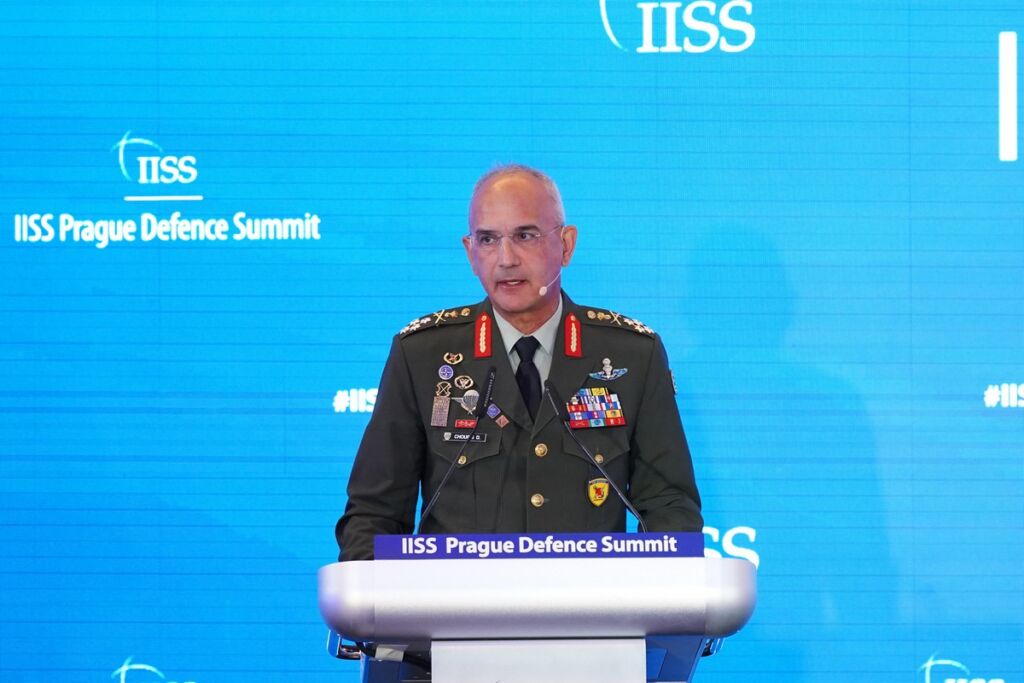
Chief of the Hellenic National Defence General Staff Addresses the IISS Prague Defence Summit
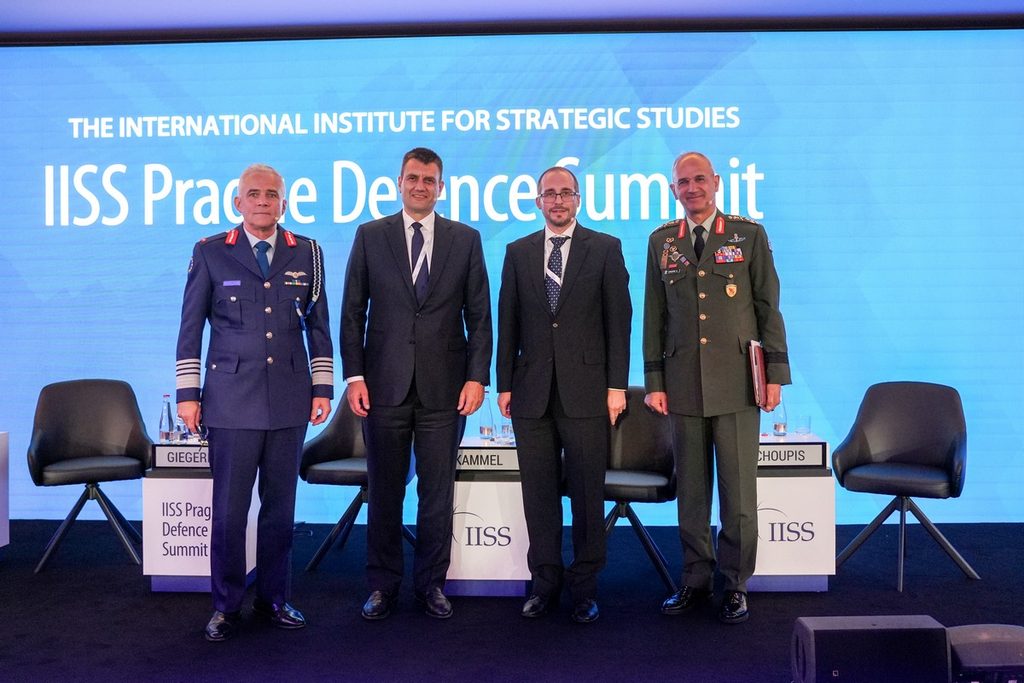
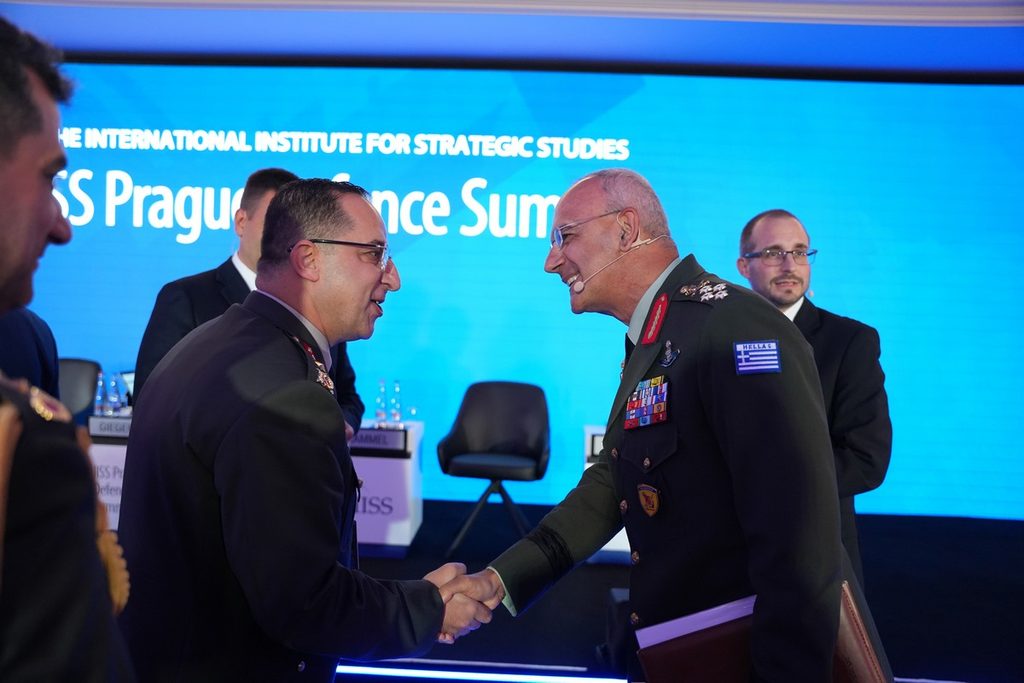
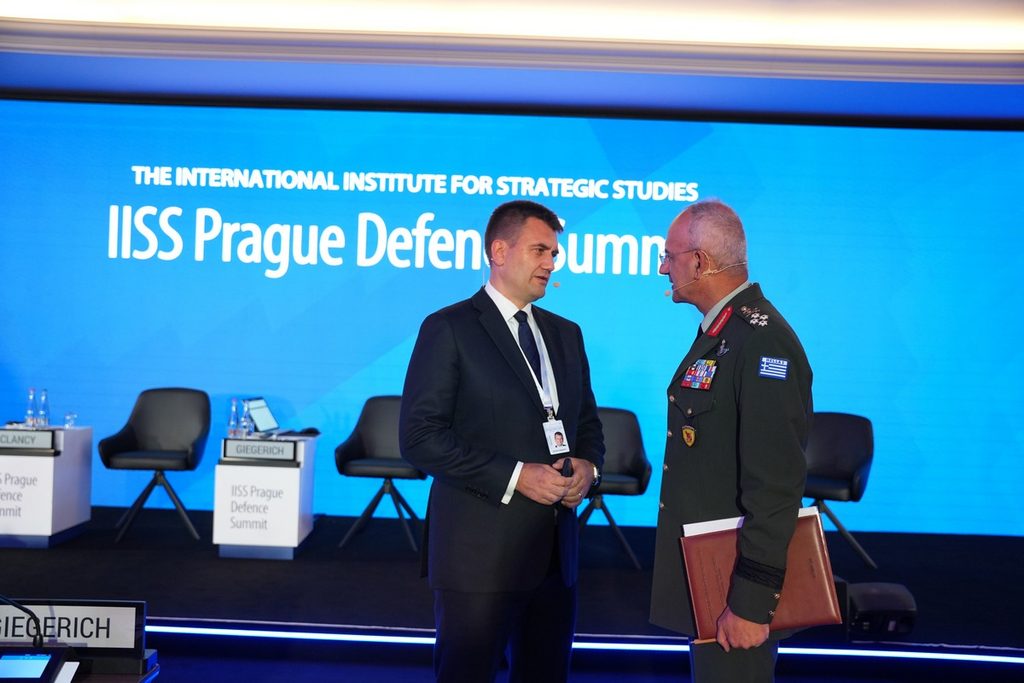
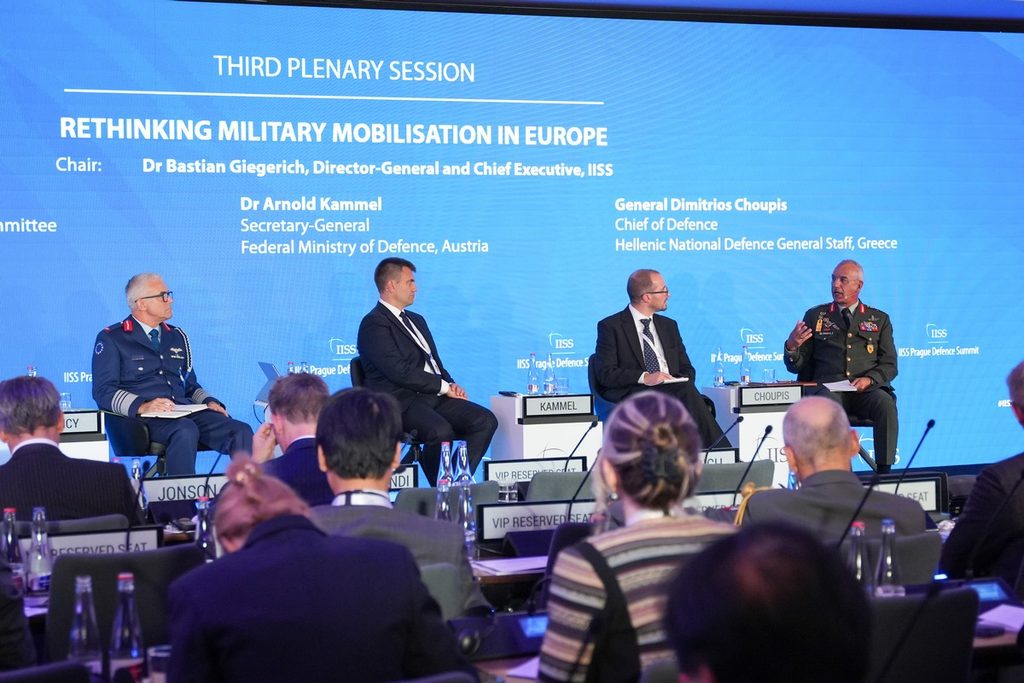
On Thursday, 17 September 2026, the Chief of the Hellenic National Defence General Staff, General Dimitrios Choupis, participated as a speaker at the third IISS Prague Defence Summit, organised by the International Institute for Strategic Studies (IISS) from Wednesday, 16 September, to Friday, 18 September 2026.
The Summit brought together 250 government and military officials, representatives of the defence industry, analysts and members of the media from across the Euro-Atlantic community and beyond to discuss current challenges and the prospects for developing Europe’s defence capabilities.
The Chief of the Hellenic National Defence General Staff addressed the Summit’s third thematic session, entitled “Rethinking Military Mobilisation in Europe”. In his speech, he highlighted the need to reconsider Europe’s approach to military mobilisation and conscription in light of contemporary threats and technological developments. He placed particular emphasis on developing more agile and resilient Armed Forces and adopting a holistic approach that connects defence with society while strengthening civil-military cooperation.
RETHINKING MILITARY MOBILISATION IN EUROPE
“Distinguished colleagues, esteemed attendees of this prestigious Forum,
We gather at an inflection point in European security. The comfortable assumptions that shaped our force structures for three decades are now tested. The return of high-intensity warfare, coupled with technological disruption, compels us to undertake a fundamental reassessment of how we mobilise and sustain our military capabilities.
This concerns concrete institutional choices and infrastructure investments that will determine whether European nations can mount credible deterrence and sustain operations over months, years and not weeks, if called upon to do so.
The empirical evidence from the past four years is definitively instructive. Legacy conscription models struggle to align manpower with modern operational demands and militaries dependent on civilian infrastructure face vulnerabilities in cyber and information domains that military-only responses cannot address.
Today, I would like to talk about a series of interconnected dimensions of military mobilization: conscript force specialization and societal integration; educational and technological infrastructure; civil-military integration; and technological modernization.
The first aspect relates to the functional separation between professional and conscript forces.
Worldwide professional standing armies, however capable, are mainly employed for a 24/7 territorial defence and secondly for national population protection. These functions in some EU nations are combined with conscript forces.
Professional forces worldwide optimize for expeditionary operations; conscript forces for territorial security. This is not a resource constraint but a strategic principle. This distinction is critical because mobilization is not a military, but rather a societal process. Mobilization requires that civilian populations internalise collective defence responsibility, understand themselves as part of the defence architecture, and integrate military service into their cultural and institutional fabric. This is an idea deeply rooted in the ancient call: “One omen is best: to defend one’s country.” As sung by Homer in his epic poem, the Iliad, it captures the enduring principle that the defence of one’s homeland is a shared responsibility.
Across Europe, nine EU member states maintain conscription, and this number is increasing, marking a reversal of a twenty-year trend. This reflects a collective recognition: professional forces alone cannot generate the scale of defence capacity Europe as a continent requires.
NATO’s professional force model with regards readiness, procedures and mobilizable military personnel cannot meet this requirement. The deeper requirement is societal: creating populations that understand territorial defence as civic responsibility in their civilian identities.
Greece, through its “AGENDA 2030” Strategic Plan, has been restructuring its conscription through an “Active volunteer reserve” model, around three principles, which are directly connected to the ancient Greek “Hoplite-Citizen” concept, which emphasized that those who belonged to the Polis were also responsible for defending it. Its purpose was to transform defence from the task of a professional military elite into a shared civic duty.
First: geographic assignment based on origin and permanent residence creates improved retention and enhanced community defence capacity, given that conscripts defend their geographical communities and not some abstract territory.
Second: technological parity with professional forces means that conscripts must achieve equivalent technological competence through ongoing exposure to evolving systems. Gen Z soldiers are skeptical about conscription that is not linked to technological advances. They must be encouraged to view military service as an enhancement of their technical skills and not an interruption of their professional progress. This aspect is more virtual and technology related. Therefore, the generational factor is always relevant.
Third: acceleration of operational deployment, with seventy percent achieving operational commitment within fourteen weeks. This reflects a strategic judgment: the window between training completion and operational engagement should be minimized, thanks to the acquisition of new tools and skills and a focus on advanced technological lethal and not lethal weapons, and effectors use (like drones, cyber, AI, e.g.)
Mobilization for GREECE is also linked to technological advancements. Digital cloud platforms for conscript notification, distributed command authority, and personalized internet-based training are not supplementary but foundational elements to the modern mobilization command, control, coordination, cyber and rapid communication at scale. A nation cannot mobilize timely and effectively if it lacks robust state-managed, cyber-protected technological infrastructure, able to properly function during rapidly crisis.
Modern mobilization capacity also creates the requirement for the education system to systematically prepare citizens for mobilization, supporting the understanding of collective defence responsibility and normalising the idea that defence is integrated into civilian professional identity.
Greece is ambitiously moving towards a more systematic mobilization model that integrates the specialized national expertise of former conscripts to be professionals, structured civilian engagement, a pilot program for conscription of women in order to be professionals in specific skill areas, and outsourcing dual use mechanisms.
And this is so because modern defence operations demand – among others – cybersecurity professionals, logistics technicians, data analysts, communications engineers. By establishing contractual frameworks with civilian professionals during peacetime, nations create reserves of expertise that can be rapidly mobilised during crisis. Greece is moving in this strategic integration, which transforms mobilization from a purely military function into a civilian-military integration and interaction mechanism where skilled civilian professionals become a force multiplier for defence capability, giving militaries access to expertise they could never afford to sustain independently.
An equally significant dimension is the integration of civilian and military systems in what European strategists increasingly term the “total defence” or “whole-of-society” models.
Modern military mobilization cannot succeed if defence is treated exclusively as a military function. A mobilized force depends on civilian infrastructure and supply chains, whereas civilian systems face asymmetric threats from cyber warfare and precision strikes. This interdependence is structural and non-negotiable. Consequently, civil-military cooperation creates measurable operational synergy tested through regular exercises. Civilian resilience and military readiness are mutually reinforcing when properly institutionalised.
Greece is operationalizing this integration framework through the dual-use infrastructure approach. Rather than maintaining separate civilian and military infrastructure systems, other government authorities, we are deliberately designating military facilities, transport nodes, government cloud software tools and industrial capacity as dual-use assets, functioning as both civilian infrastructure in peacetime and military mobilization infrastructure in crisis.
The last consequential dimension is technological modernization coupled with adapted operational doctrine, which affiliate all lessons learned from current conflicts and technological achievements. This is where future mobilization decisions mostly diverge from historical models. Nations clinging to Cold War conscription models will operate with technologically inferior forces. Nations integrating conscription with professional specialization, combined with sustained technological investment, including hybrid deterrence and dual-use approach, will inevitably achieve valuable holistic deterrence.
What is significant is that European nations are no longer treating this reality as abstract choices, but operationally concrete institutional reforms and infrastructure investments. Mobilization must be reconceived as a government strategy at the societal level, not as a military procurement problem. The geopolitical window for this transformation is open but narrowing. Nations institutionalizing these reforms over the next three to five years will position themselves for credible holistic deterrence through 2035.
Europe’s military mobilization is ultimately a test of whether European societies can undertake systemic institutional renewal in an era of accelerating the existing threats in a continent in which Geography produces history. The resources exist and so do the technical frameworks. The strategic and political necessity is becoming undeniable. What remains is the sustained will to transform education systems, technology infrastructure, military structures, and citizen mindset mentality with coherence and discipline.
History has taught us a simple, yet an enduring lesson: winners, who ultimately prevail, have always been those who had the foresight to anticipate developments, the preparedness to act, and the absolute resolve to shape the events rather than be shaped by them.”
 English
  Greek
Greek