


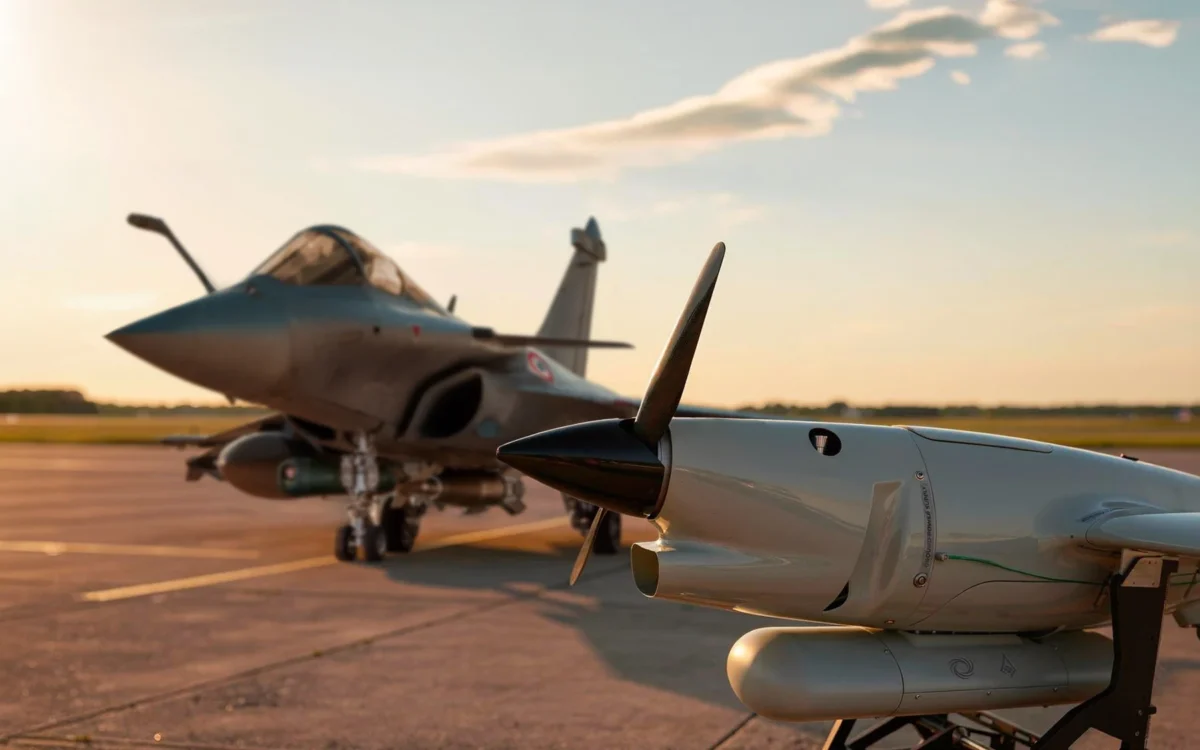
Dassault Aviation and Harmattan AI Successfully Demonstrate NAMIB Electronic Warfare Payload in Collaborative Rafale Flight
Paris, France – Dassault Aviation and Harmattan AI have successfully completed the first collaborative flight demonstration between a Rafale F4 fighter aircraft and an unmanned aerial system equipped with NAMIB, a new electronic warfare (EW) payload jointly developed by the two companies.
The trial marks a significant milestone in the integration of autonomous systems into modern air combat operations. During the demonstration, the NAMIB-equipped drone detected, identified and accurately geolocated electromagnetic emissions from a simulated enemy radar located several dozen kilometres away. The target coordinates were transmitted in real time to the Rafale F4, which subsequently conducted a simulated strike against the detected air defence system.
Designed as a compact and highly capable electronic warfare payload, NAMIB can be integrated on a wide range of unmanned aerial platforms, from tactical quadcopters to fixed-wing drones with extended endurance. Its primary role is the detection, identification and geolocation of hostile electromagnetic emitters, particularly radar systems associated with integrated air defence networks.
The programme, launched in January 2026, forms one of the flagship initiatives under the strategic partnership between Dassault Aviation and Harmattan AI, which seeks to accelerate the incorporation of advanced autonomous technologies into future collaborative combat architectures.
Eric Trappier, Chairman and CEO of Dassault Aviation, highlighted the significance of the achievement, stating that the demonstration validates the Rafale F4’s ability to operate effectively within a multi-domain collaborative combat environment. He noted that the aircraft’s F4 architecture enables seamless connectivity with a broad range of operational assets, including unmanned systems and ground forces, allowing it to exploit new capabilities such as NAMIB’s electromagnetic detection and geolocation functions. He also emphasized that the demonstration illustrates the Rafale’s continuous evolution to meet emerging operational requirements, including the increasingly important “high-low mix” concept, which combines advanced manned platforms with autonomous and expendable systems.
Mouad M’Ghari, Co-Founder and CEO of Harmattan AI, stressed that electronic warfare has become a decisive factor in achieving battlefield superiority. He explained that NAMIB demonstrates how sophisticated EW capabilities can now be deployed on lightweight autonomous systems operating close to hostile threats. According to M’Ghari, the successful demonstration reflects the complementary expertise of Dassault Aviation in combat aircraft and Harmattan AI in autonomous systems and embedded intelligence, paving the way for next-generation collaborative combat solutions.
Harmattan AI specialises in the development of autonomous defence systems covering air defence, intelligence, surveillance and reconnaissance (ISR), strike missions, electronic warfare and command-and-control applications. The company operates across North America, Europe, the Middle East and Africa, supporting allied armed forces with scalable autonomous capabilities.
With more than 10,000 military and civil aircraft delivered to over 90 countries during its 110-year history, Dassault Aviation continues to expand the operational capabilities of the Rafale through the integration of advanced networking, artificial intelligence and autonomous technologies, reinforcing its position as one of the world’s leading combat aircraft manufacturers.
 English
  Greek
Greek