


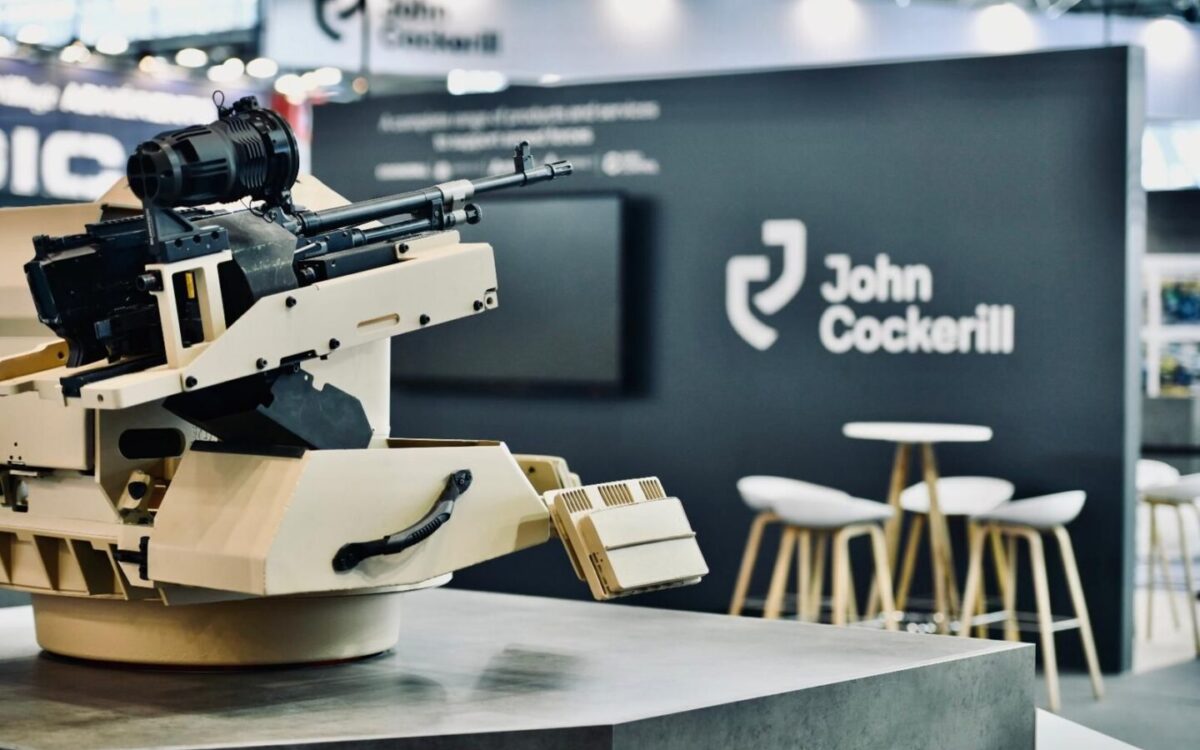
John Cockerill Defense Expands Counter-Drone Portfolio for Armoured Vehicles
At Eurosatory 2026, John Cockerill Defense showcased an expanded portfolio of integrated counter-unmanned aerial system (C-UAS) solutions designed to enhance the self-protection of armoured vehicles against the rapidly evolving drone threat. The new systems combine radar sensors, artificial intelligence, remote weapon stations and electronic warfare capabilities to provide layered protection for a wide range of combat platforms.
One of the key demonstrations is taking place on the stand of the French Ministry of the Armed Forces, where the Operational Adaptation Kit for Counter-UAV (KAO LAD) has been integrated onto a Hornet T1 remotely operated weapon station installed on a Serval 4×4 armoured vehicle. Developed through cooperation between John Cockerill Defense, the Direction générale de l’armement (DGA) and the Section Technique de l’Armée (STAT), the demonstrator illustrates how remotely operated turrets can integrate radar sensors and dedicated fire-control software to detect, track and engage hostile unmanned aerial systems.
Building on this capability, the company unveiled the Hornet Air Guard, an operational counter-drone system incorporating enhanced detection capabilities together with radio-frequency (RF) neutralisation technology developed in partnership with MC2. In addition to its display on the John Cockerill Defense stand, the system is also being exhibited by MBDA, Thales and AM General, underlining its compatibility with multiple armoured vehicle platforms.
Recognising that the drone threat extends beyond light tactical vehicles, John Cockerill Defense also introduced the Hornet S Air Guard, a new concept designed to provide 360-degree counter-drone protection for medium- and large-calibre turreted combat vehicles, including platforms equipped with the Hornet S and Hornet T3 weapon stations, such as the French Army’s EBRC Jaguar. The system is intended to extend surveillance and defensive coverage without compromising the primary combat capabilities of the host vehicle.
The company’s broader counter-UAS architecture incorporates several proprietary technologies, including artificial intelligence algorithms for automatic drone detection, classification and target tracking, together with advanced fire-control software and electronic countermeasures. John Cockerill Defense is also adapting its CLWS remotely operated weapon station armed with a 25 mm cannon for specialised counter-drone missions, providing an additional kinetic option against increasingly sophisticated aerial threats.
By integrating radar, artificial intelligence, electronic warfare and remotely operated weapon systems into a common architecture, John Cockerill Defense aims to offer scalable counter-drone solutions that can be readily integrated onto both new and existing armoured vehicles. As armed forces increasingly seek layered protection against the growing proliferation of unmanned aerial systems on the modern battlefield, the company is positioning its expanding C-UAS portfolio as a comprehensive response to one of today’s fastest-evolving operational challenges.
 English
  Greek
Greek