


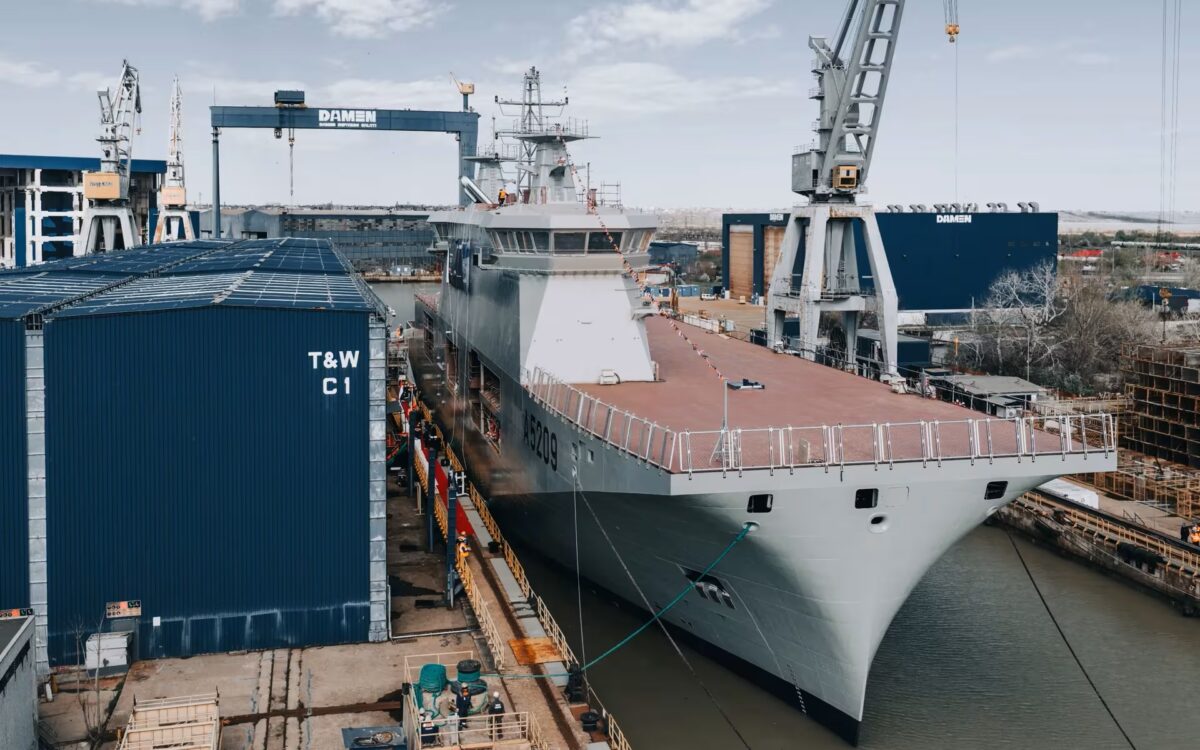
Damen Launches NRP D. João II, Portugal’s Next-Generation Multi-Purpose Vessel
Damen Shipyards Group has launched the NRP D. João II, a new Multi-Purpose Vessel (MPV 10720) for the Portuguese Navy, marking a notable step in Europe’s shift toward flexible, multi-role naval platforms. The vessel entered the water at Damen Shipyards Galati in Romania in a ceremony attended by senior naval representatives and diplomatic officials, underlining the programme’s broader European dimension.
The MPV 10720 stands out for its origin as a concept driven directly by the Portuguese Navy. Rather than following a traditional single-role design philosophy, the vessel reflects a forward-looking operational requirement for a platform capable of performing a wide range of missions. Designed with a high level of system autonomy, D. João II is intended for deployment across diverse environments, from tropical to temperate waters, supporting activities such as maritime surveillance, oceanographic research, environmental monitoring, and humanitarian assistance.
This approach mirrors a wider evolution among European navies, which are increasingly prioritising adaptable platforms capable of addressing both conventional security tasks and emerging non-traditional missions. In this context, the MPV 10720 represents a hybrid solution, combining naval support functions with scientific and civil protection roles within a single hull.
Damen secured the contract for the vessel following a competitive tender process, with the programme benefiting from funding through the European Union’s Recovery and Resilience Facility, part of the NextGenerationEU framework. The project has been developed in close cooperation with the Portuguese Navy and a network of European suppliers, enabling the integration of military-grade systems with modular and standardised shipbuilding solutions.
The collaboration has also contributed to the development of Damen’s broader Multi-Purpose Support Ship portfolio, which targets vessels in the 7,000 to 9,000-ton range. These designs are intended to deliver cost efficiency and reduced build times while maintaining the operational flexibility required by modern naval forces. The relatively rapid progression of the D. João II programme reflects these industrial efficiencies, as well as the benefits of a clearly defined operational concept from the outset.
As the vessel moves into the next phase of testing and preparation, it is expected to enhance Portugal’s ability to operate across a spectrum of maritime domains. Beyond national requirements, the ship is also positioned to contribute to wider European maritime operations, including security missions, scientific initiatives, and disaster response efforts.
The naming of the vessel carries symbolic weight, honouring King João II, a key figure in Portugal’s Age of Discovery and a monarch closely associated with maritime expansion and innovation. This historical reference reinforces the continuity between Portugal’s naval heritage and its modern ambitions at sea.
Once operational, D. João II will join other Damen-built vessels already in Portuguese service, further consolidating the relationship between the navy and the Dutch shipbuilder. More broadly, the programme illustrates a growing trend in naval design toward multi-mission platforms that prioritise flexibility, interoperability, and efficiency, qualities that are increasingly essential in a complex and rapidly evolving maritime security environment.
 English
  Greek
Greek