



Greece Signs Contract for 52 RAM Block 2A Missiles to Enhance Naval Point Defence
The Hellenic Ministry of National Defence, through the General Directorate for Defence Investments and Armaments (GDDIA), has signed a contract for the procurement of 52 Rolling Airframe Missile (RAM) Block 2A guided missiles, reinforcing the close-in defensive capabilities of the Hellenic Navy.
The agreement (Contract 001B/25) was signed on 10 March 2026 by GDDIA Director General Major General Ioannis Bouras with RAM-System GmbH, the German-based joint venture responsible for the RAM programme.
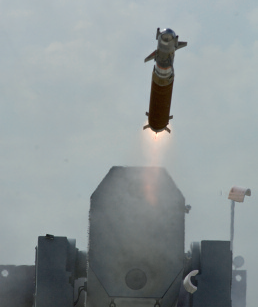
The RAM (RIM-116) is a fire-and-forget Close-In Weapon System (CIWS) designed to provide ship self-defence against a wide spectrum of threats, including anti-ship missiles, helicopters, aircraft, and surface targets. It is particularly effective in complex operational environments, including littoral zones and high-density saturation attacks.
The Block 2A variant incorporates significant upgrades over earlier configurations, including a more powerful rocket motor, enhanced manoeuvrability, and an improved dual-mode seeker combining radio frequency (RF) and infrared (IR) guidance. These enhancements enable the missile to counter highly agile threats and detect targets employing low-probability-of-intercept radar techniques.
RAM has demonstrated a high level of operational effectiveness, achieving a kill probability exceeding 95% in more than 350 flight tests and live firings. The system is capable of engaging multiple simultaneous threats, including sea-skimming and diving anti-ship missiles.
The system is deployed in two primary configurations: the Mk 31 launcher with 21 missiles integrated into a ship’s combat management system, and the SeaRAM configuration, which offers an autonomous solution with onboard sensors and 11 missiles.
The RAM programme is jointly developed and produced by RAM-System GmbH in cooperation with its US partner Raytheon Missiles & Defense. Key industrial stakeholders include Diehl Defence and MBDA Deutschland.
Currently, RAM systems are in service with several navies worldwide, including those of the United States, Germany, Greece, South Korea, the United Arab Emirates, Egypt, and Turkey, with over 200 systems and more than 4,500 missiles delivered.
The acquisition is expected to further enhance the survivability of Hellenic Navy surface units, particularly in response to evolving anti-ship missile threats and the increasing complexity of the maritime battlespace.
The RAM system MK-31 consists of the missile
RIM-116 and the Guided Missile Launching System
(GMLS) MK-49. The GMLS holds 21 RAM Block 1
or RAM Block 2 RIM-116 missiles and is integrated
with the Command & Control system of the naval
platform.
• The SeaRAM system holds 11 RIM-116 missiles and
provides a fully autonomous CIWS solution including
detection and fire control sensors.
• The German Navy relies on the RAM ship self-
defence weapon system for its K130 corvettes as
well as the F123, F124 and F125 class frigates. RAM
will also be integrated on the new multi-purpose
combat ship MKS180.
• The US Navy has installed RAM on more than 40
ships particularly on high value units like Aircraft
Carriers, Amphibious Assault and Transport Ships.
Recently the US Navy decided for RAM on the LCS
Freedom class and SeaRAM on the LCS Independent
class.
• RAM is being in production since 1989 is opera-
tional on approx. 100 ships of the navies of Ger-
many, USA, Greece, South Korea, UAE, Egypt and
Turkey. In total, more than 200 weapon systems
and 4500 missiles have been produced and delivered so far.
RAM BLOCK 2 Missile characteristics
• Weight: 88 kg
• Length: 2,9 m
• Diameter: 160 mm
• Speed: supersonic
• Range: > 10 km
• Seeker: RF & IR
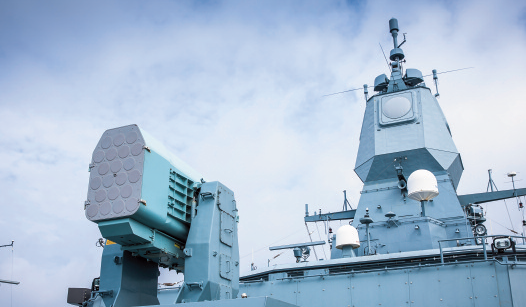
© Photo credit: MBDA

 English
  Greek
Greek