


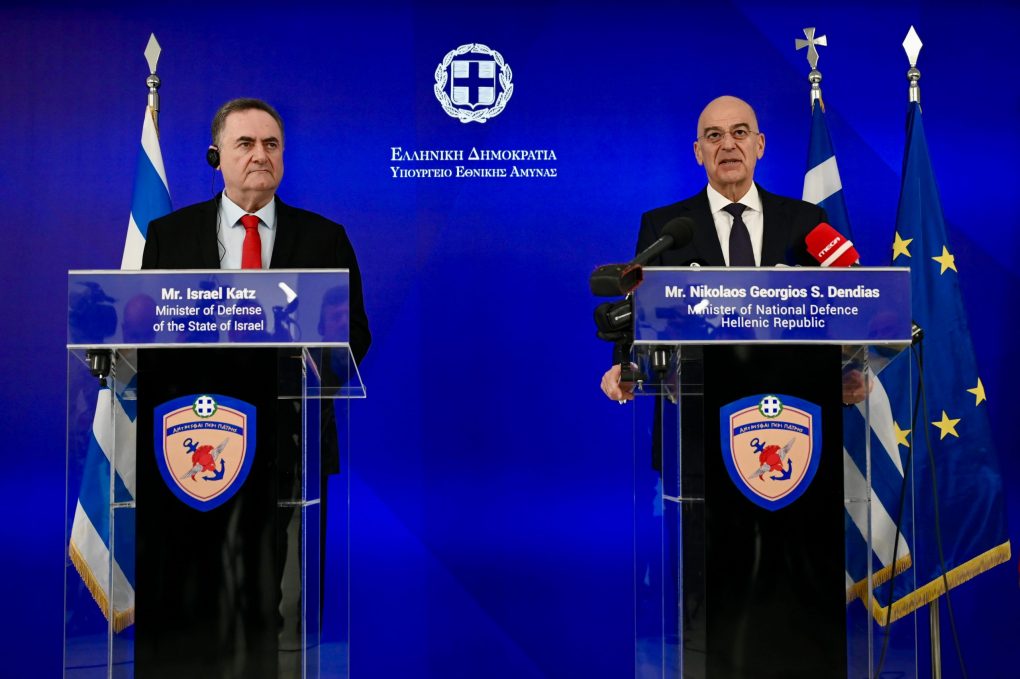
Greece and Israel Deepen Strategic Defence Partnership in Athens Talks
The strategic convergence between Greece and Israel took another decisive step forward on 20 January 2026, when Greek Minister of National Defence Nikos Dendias hosted Israeli Minister of Defence Israel Katz in Athens. The meeting, held at the Hellenic Ministry of National Defence, underscored the maturity of bilateral relations and their growing relevance within an increasingly volatile regional and global security environment.
Following a private discussion, the two ministers led expanded talks between their respective delegations, focusing on the evolution of defence cooperation and the challenges posed by modern warfare. At the core of the dialogue was the recognition that contemporary conflicts are shaped less by conventional force alone and increasingly by technology, innovation, and multidomain operations.
Minister Dendias highlighted that Greek–Israeli defence cooperation now spans the full operational and strategic spectrum: from interoperability and joint exercises to research, innovation, defence technology, and industrial collaboration. He recalled that only weeks earlier, the two sides had signed the Defence Cooperation Programme for 2026, providing for 29 activities in Greece and 25 in Israel—an indicator of both the intensity and institutional depth of the relationship.
A central theme of the talks was the transformation of warfare in the 21st century. The ministers agreed to intensify cooperation in addressing threats posed by unmanned systems, including drone swarms and unmanned underwater vehicles, as well as cyber-domain challenges. These areas reflect Israel’s comparative technological advantage and Greece’s determination to modernise its deterrence posture under the “Agenda 2030” reform programme.
Dendias drew particular attention to Israel’s evolution from a defence importer into a global leader in high-end military technologies such as missile defence, counter-UAS systems, sensors, and cyber platforms. Inspired by this model, Greece has established the Hellenic Centre for Defence Innovation (ELKAK), aiming to transform the country from a mere buyer of defence systems into a co-producer and developer of innovative, dual-use technologies.
Early results are already visible. Greek-developed counter-drone systems are being integrated into the Hellenic Navy, while domestically produced unmanned platforms are entering service. Both sides agreed to strengthen cooperation between ELKAK and Israeli innovation bodies, with the expectation that this partnership will yield practical, exportable solutions.
Beyond bilateral cooperation, the meeting reaffirmed the strategic importance of the “3+1” framework linking Greece, Cyprus, Israel, and the United States. Dendias described this alignment as a stabilising axis in the Eastern Mediterranean, a region increasingly exposed to legal contestation, geopolitical rivalry, and destabilising practices. Greece, he stressed, defends its sovereignty and sovereign rights without threatening others, relying instead on credible deterrence and adherence to international law, including the Law of the Sea.
The discussions also extended to the broader Middle East. Dendias reiterated Greece’s condemnation of the 7 October terrorist attacks and its support for Israel’s right to self-defence and for the return of all hostages. He outlined Greece’s support to the Lebanese Armed Forces and emphasised that the protection of Christian communities in Syria and Lebanon remains a strategic and moral priority for Athens.
In closing, Dendias framed the Greek–Israeli relationship as more than a bilateral partnership. It is, he argued, a contributor to regional stability, anchored in shared values, technological cooperation, and a common understanding of emerging threats. The Athens meeting confirmed that Greece and Israel are not merely coordinating—they are shaping a forward-looking defence architecture for the Eastern Mediterranean.
 English
  Greek
Greek